At exactly 100 kilometres north of Poitiers—a straightforward hour's drive along the A10 motorway—the city of Tours stands as the historic capital of the Loire Valley and your gateway to France's most famous châteaux. This elegant city of 145,000 residents sits on the Loire river at the heart of a UNESCO World Heritage landscape, surrounded by Renaissance castles, world-class vineyards, and some of the most refined architecture in France. For British visitors staying in Poitiers, Tours offers something genuinely transformative: a complete change of scenery without the commitment of relocating your base. You can explore medieval half-timbered streets in the morning, tour a Loire château in the afternoon, taste Vouvray wines before dinner, and be back in Poitiers by evening. Alternatively, Tours makes an excellent overnight base for a two-day Loire Valley château circuit. This is the complete guide to visiting Tours from Poitiers.
Why Visit Tours from Poitiers?
Tours occupies a privileged position in French history. Capital of the Touraine region, it served as France's effective capital when Louis XI ruled from nearby Château de Plessis-lès-Tours in the 15th century. The city's wealth derived from silk weaving in the Renaissance, banking in the 18th century, and—crucially for visitors—its role as administrative center for the Loire château region. Today Tours combines genuine urban sophistication (excellent restaurants, museums, shopping) with unparalleled access to the Loire Valley's crown jewels: Château de Chenonceau sits 35km east, Château d'Amboise 25km east, Château de Villandry 15km southwest, Azay-le-Rideau 30km southwest. If you want to visit Loire châteaux without relocating from Poitiers, Tours is your ideal staging post—close enough for day trips (1h drive), interesting enough to justify the journey even without château visits.
The old town—Vieux Tours—preserves one of France's finest collections of medieval timber-framed houses, particularly around Place Plumereau where outdoor café terraces create a Continental atmosphere rarely matched in provincial French cities. Saint-Gatien Cathedral, with its flamboyant Gothic façade and Renaissance dome, rivals Chartres for architectural ambition. The Loire wines—Vouvray's sparkling and sweet whites, Chinon's elegant reds, Bourgueil's approachable Cabernet Francs—are accessible through dozens of wine bars and tasting rooms scattered across the city center. For British visitors, Tours offers a complete urban experience without Paris prices or Paris crowds, combined with château access impossible to achieve from anywhere else. See our day trips from Poitiers guide for other regional excursions.
Getting to Tours from Poitiers
By Car (Most Flexible): The drive from Poitiers to Tours covers exactly 100 kilometres via the A10 motorway northbound. Journey time is 55-65 minutes in normal traffic, occasionally extending to 75 minutes during peak commuter hours (08:00-09:30, 17:00-18:30 weekdays). Exit the A10 at Junction 23 (Tours Centre) and follow signs into the city center—parking is well-signposted. Péage tolls from Poitiers to Tours cost approximately €7-9 each way. The A10 route is straightforward: join the motorway from Poitiers (direction Paris), drive north for 45 minutes, exit at Tours. If you are driving from the UK to Poitiers, see our driving from Calais guide for A10 motorway familiarity.
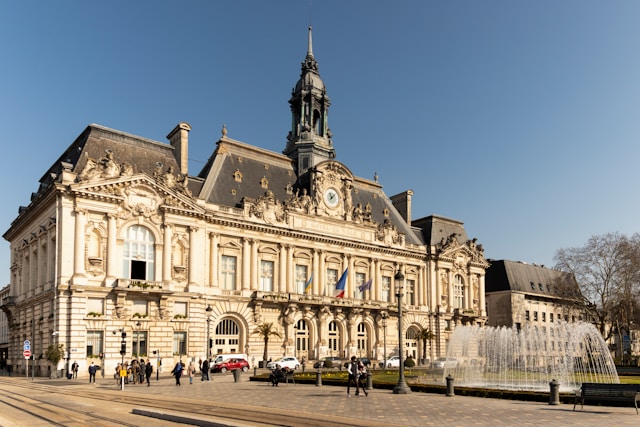
Parking in Tours: City center parking operates via multi-story car parks (€2-2.50/hour, €15-20 daily maximum). Best options: Parking Anatole France (Place Anatole France, 300m from Vieux Tours, €16 daily), Parking République (Rue Jules Favre, beside Hôtel de Ville, €18 daily), Parking Vinci Gare (beside Tours train station, €14 daily—useful if combining train + car). Street parking (€1.50-2/hour, maximum 2-hour limit) exists but spaces fill rapidly. For château visits, park at Tours in the morning, drive to chosen château mid-morning, return Tours afternoon—this minimizes urban parking fees.
By Train (Faster, More Expensive): Direct TGV trains connect Poitiers to Tours in 35-45 minutes, operating 6-10 times daily depending on season. Fares range €15-35 one-way depending on booking timing and train class. Book 2-4 weeks ahead for €15-20 tickets; last-minute fares reach €30-35. Trains depart Poitiers station hourly during peak periods (07:00-09:00, 17:00-20:00), every 2-3 hours mid-day. Check SNCF.com or Trainline for exact schedules. Tours station sits 1km south of city center—walk 15 minutes or take tram (Line A direction Lycée Français, €1.70 single, 5 minutes to Jean Jaurès stop in city center). For château visits, some require car rental from Tours (Europcar, Hertz, Sixt operate from Tours station) which negates the train cost advantage. See our Paris to Poitiers train guide for TGV booking strategies applicable to Poitiers-Tours routes.
Car vs Train Decision: Train wins if you are visiting Tours city only (no château side trips), staying overnight (avoid parking fees), or traveling solo/couple without luggage needs. Car wins if visiting châteaux (essential for Chenonceau, Villandry, Azay-le-Rideau which lack convenient public transport), traveling with family (4+ people, car becomes cheaper), or combining Tours with wine route visits. For a full-day château circuit from Poitiers, the car is mandatory.
Exploring Tours: Old Town & Key Sights
Place Plumereau & Vieux Tours: The heart of Tours' old town is Place Plumereau, a cobbled square surrounded by 15th-century half-timbered houses with overhanging upper floors and carved wooden beams. The square transforms throughout the day: morning café breakfasts for students from nearby Université de Tours, lunchtime tourists at terrace restaurants, evening aperitifs when locals reclaim the square. The surrounding streets—Rue du Grand Marché, Rue de la Rôtisserie, Rue Briçonnet—preserve similar timber-frame architecture, many now housing boutiques, wine bars, and crêperies. This is Tours at its most photogenic and most touristy; arrive before 10:00 or after 18:00 to appreciate the architecture without crowds.
Cathédrale Saint-Gatien: Tours' Gothic cathedral (13th-16th centuries) sits at the eastern edge of the old town, notable for its asymmetrical towers—one Gothic, one Renaissance—and extraordinary stained glass windows spanning five centuries of glasswork evolution. The Flamboyant Gothic west facade, completed around 1550, represents late medieval architectural ambition at its peak: tier upon tier of carved stonework rising to needle-sharp pinnacles. Free entry, open 09:00-19:00 daily. The cathedral cloister (La Psalette) requires €3 entry but offers access to Renaissance architecture and temporary exhibitions—worth the fee if you appreciate architectural detail, skippable if pressed for time. The cathedral sits on Place de la Cathédrale beside the Musée des Beaux-Arts; allow 30-45 minutes for cathedral visit.
Musée des Beaux-Arts: Installed in the former Archbishop's Palace beside the cathedral, Tours' fine arts museum holds exceptional collections spanning medieval sculpture to contemporary photography. Highlights include Mantegna's Christ in the Garden of Olives and The Resurrection (Italian Renaissance masterworks rarely seen outside major capitals), Rubens' dramatic religious paintings, and comprehensive 19th-century French painting (Delacroix, Monet, Degas). The museum gardens—formal French parterre design with towering cedar trees—provide peaceful retreat. Entry €6, closed Tuesdays, open 09:00-18:00 Wed-Mon. Allow 90 minutes minimum; serious art enthusiasts could spend half a day.
Rue Nationale & Modern Tours: Tours' main shopping street, Rue Nationale, runs north-south connecting the train station to the Loire riverfront. Completely pedestrianized, it houses French high street brands (Zara, H&M, Fnac), local boutiques, and numerous cafés. Less picturesque than Vieux Tours but genuinely French—this is where Tours residents shop, not tourists. The parallel Rue de Bordeaux offers higher-end boutiques and design shops. Both streets provide useful context for Tours as functioning city rather than museum piece.
Loire River & Bridges: Tours sits on the Loire's north bank, connected to the southern suburbs by the Pont Wilson—an elegant 18th-century stone bridge with multiple arches. Walking the bridge offers panoramic Loire views and perspective on the river's width (300+ meters at Tours). The riverbanks—particularly Quai d'Orléans on the north bank—provide pleasant walking paths lined with plane trees, popular with joggers and cyclists. The Loire at Tours lacks the dramatic castle-topped hills of Saumur or Amboise, but its unhurried flow through flat landscape captures the river's essential character.
Loire Châteaux Access from Tours
Tours' primary value for Poitiers visitors is château access. The four most accessible châteaux from Tours—Chenonceau, Villandry, Azay-le-Rideau, and Amboise—each offer distinct architectural and historical perspectives on Loire Valley Renaissance culture.
Château de Chenonceau (35km east, 40min drive): The most visited château after Versailles, Chenonceau is unmissable—the Renaissance building spans the Cher river via a gallery bridge, creating the iconic water-palace silhouette appearing on every Loire Valley postcard. Built 1514-1522 by Katherine Briçonnet, later expanded by Diane de Poitiers and Catherine de Medici, the château embodies female patronage in French Renaissance architecture. The formal gardens—Diane's geometric parterre versus Catherine's more elaborate designs—provide outdoor counterpoint to sumptuous interior furnishings. Entry €16-18 (varies by season), open 09:00-19:00 daily April-September, reduced winter hours. Crowds arrive 10:30-15:00; visit before 10:00 or after 16:00 to appreciate the château without tour group chaos. Allow 2-3 hours minimum. Drive from Tours via D976 east to Bléré, then D40 south to Chenonceau village; parking €2. Combine morning Chenonceau visit with afternoon in Tours or Amboise.
Château de Villandry (15km southwest, 20min drive): While Villandry's Renaissance architecture is handsome, visitors come for the gardens—six terraces of formal French garden design representing 500 years of horticultural evolution. The ornamental kitchen garden (Potager de la Renaissance) arranges vegetables in geometric patterns of stunning beauty; the ornamental garden uses 52,000 bedding plants changed twice annually to create floral tapestries; the water garden provides Zen-like contemplation. Spring (April-May tulips) and summer (June-August roses) offer peak garden displays. Entry €12-13, gardens open 09:00-sunset daily year-round, château interior 09:00-18:00. Allow 1.5-2 hours garden visit. Drive from Tours via D751 southwest toward Azay-le-Rideau, exit at Villandry; parking free. Combine Villandry morning with Azay-le-Rideau afternoon (20km, 25min drive).
Château d'Azay-le-Rideau (30km southwest, 35min drive): Set on an island in the Indre river, Azay-le-Rideau represents early French Renaissance architecture at its purest—Italian Renaissance symmetry applied to French Gothic verticality, creating harmonious proportions rarely achieved in subsequent Loire châteaux. Built 1518-1527 by Gilles Berthelot (financier to François I), the château now houses a museum of Renaissance decorative arts. The English-style park surrounding the château offers peaceful walking beneath mature trees. Entry €11-12, open 09:30-18:00 daily April-September, reduced winter hours. Crowds manageable compared to Chenonceau. Allow 1.5-2 hours. Drive from Tours via D751 southwest through Villandry; parking free beside château. Azay-le-Rideau village offers several good lunch restaurants if combining château visits.
Château d'Amboise (25km east, 30min drive): Perched on a cliff above the Loire, Amboise served as royal residence for François I in his youth and later became Leonardo da Vinci's final home (he lived at nearby Clos Lucé, walking distance from the château). The château interior is partially ruined—much was demolished in the 1800s—but the surviving royal apartments, Gothic chapel (Saint-Hubert, containing Leonardo's tomb), and panoramic Loire views justify the visit. Less architecturally refined than Chenonceau or Azay-le-Rideau, Amboise offers stronger historical narrative. Entry €14-15, open 09:00-18:00 daily April-October, reduced winter hours. Allow 1.5 hours. Drive from Tours via D751/D31 east along Loire's north bank; parking €3 in Amboise town (steep walk to château). Clos Lucé (€16-18 entry) sits 500m uphill from château—allow 2 hours if combining both sites.
Realistic Château Strategy: One château as half-day trip from Poitiers works well: depart Poitiers 08:30, arrive Tours 09:30, drive to château 10:00, visit château 10:30-13:00, lunch Tours 13:30, explore Tours 14:30-17:00, depart Tours 17:30, arrive Poitiers 18:30. Two châteaux becomes rushed but possible: Villandry morning (09:00-11:00), Azay-le-Rideau afternoon (12:00-14:00), brief Tours visit (15:00-17:00). Three châteaux requires overnight in Tours. Without a car, château visits become complicated—tour buses depart Tours daily (€50-70 half-day, €80-110 full-day) visiting 2-3 châteaux, but schedules are rigid.
Loire Valley Wines from Tours
The Touraine wine region surrounds Tours, producing white, red, rosé, and sparkling wines under multiple appellations. For British visitors, Loire wines offer refreshing alternatives to ubiquitous Bordeaux and Burgundy—lighter, food-friendly, often exceptional value.
Vouvray (10km east): The hillside town of Vouvray produces world-class Chenin Blanc wines in styles ranging bone-dry to lusciously sweet, plus sparkling Vouvray (Méthode Traditionnelle, Champagne-style production). Domaine Huet, Domaine du Clos Naudin, and Domaine François Pinon produce benchmark examples. Many Vouvray producers offer cellar tours (caves troglodytes—cellars carved into limestone cliffs) with tastings €8-15. Drive from Tours via D952 east 15 minutes. Vouvray pairs brilliantly with Loire river fish, goat cheese, or aperitif service.
Chinon (50km southwest): Chinon produces elegant red wines from Cabernet Franc grapes—lighter-bodied than Bordeaux, more structured than Beaujolais, supremely food-friendly. Domaine Bernard Baudry and Domaine Philippe Alliet are outstanding producers. Chinon town itself, dominated by medieval fortress ruins, merits a visit beyond wine tourism. Drive from Tours via D751/D749 southwest 50 minutes. Chinon reds pair perfectly with duck confit, charcuterie, or grilled Loire river fish.
Wine Bars in Tours: Numerous wine bars across Tours offer Loire wine discovery without vineyard driving. L'Atelier Gourmand (7 Rue Etienne Pallu, closed Sundays) stocks 300+ Loire wines, offers tastings €4-8 per glass, small plates €6-12. Le Serpent Volant (28 Rue Briçonnet, Vieux Tours) specializes in natural Loire wines, knowledgeable staff, relaxed atmosphere. Cave des Fusillés (6 Rue des Fusillés, near Saint-Gatien) combines wine shop with tasting bar, excellent Vouvray selection. For serious wine education, book a guided Loire wine tasting (€40-60 per person, 2-3 hours, 6-8 wines) through Tours tourist office—sommeliers provide context impossible to achieve through self-guided tastings.
Where to Eat in Tours
Tours' restaurant scene balances traditional Touraine cuisine (rillettes, rillons, Sainte-Maure goat cheese, Loire river fish) with contemporary French bistronomy and international influences from the city's student population.
La Deuvalière (Gastronomic): Michelin-starred chef Gildas Marsollier operates this intimate 30-seat restaurant focusing on seasonal Touraine ingredients prepared with modern techniques. Tasting menus €60-95 showcase Loire terroir: asparagus from Vineuil, goat cheese from Sainte-Maure, sandre (pike-perch) from the Loire. Wine pairings emphasize local producers. Lunch formula €32 (two courses) offers accessible entry to high-end dining. Reservations essential, book 1-2 weeks ahead. Closed Sunday-Monday. Address: 18 Rue de la Monnaie. This is Tours' finest dining, comparable quality to Paris restaurants at provincial prices.
Les Linottes (Bistronomic): Contemporary bistro on Place Plumereau serving refined Touraine-inspired dishes in relaxed setting. Changing seasonal menu might include Loire salmon with Vouvray beurre blanc, Touraine pork with caramelized apples, or local goat cheese tart. Lunch formula €18-22, dinner à la carte €30-45. Wine list emphasizes natural Loire producers. Terrace seating on Place Plumereau prime position for people-watching. Reservations advised for dinner, walk-ins usually accommodated for lunch. Open daily. Address: 11 Place Plumereau.
Le Bistrot de la Tranchée (Traditional): No-frills bistro serving authentic Touraine specialties: rillettes (pork pâté), rillons (crispy pork belly), andouillette (tripe sausage—acquired taste), sandre meunière (Loire pike-perch pan-fried in butter). This is where locals eat traditional cuisine without tourist markup. Lunch formula €14.50, dinner à la carte €20-30. Simple décor, efficient service, solid wine list. Closed Sunday-Monday. Address: 103 Avenue de la Tranchée (residential neighborhood, 15-minute walk from Vieux Tours). If you want authentic Touraine rather than tourist-friendly adaptations, eat here.
Café du Vieux Murier (Lunch/Casual): Relaxed café-restaurant on Place Plumereau serving salads, quiches, croque-monsieurs, daily plat du jour. Lunch formula €12-15, reliable quality, pleasant terrace. No reservations, expect 10-15 minute wait at peak lunch (12:30-13:30). Open daily 08:00-23:00. Address: 11 Place Plumereau. Perfect for casual lunch between château visits.
Full-Day Tours Itinerary from Poitiers
08:30 - Depart Poitiers by Car: Early start maximizes château and Tours time. Drive north on A10.
09:30 - Arrive Tours, Park Anatole France: €16 daily parking, central location.
09:45 - Drive to Chenonceau: 35km east, arrive 10:15 before major crowds.
10:15 - Visit Château de Chenonceau: 2-2.5 hours exploring château, gardens, outbuildings.
12:45 - Return to Tours: 40-minute drive.
13:30 - Lunch in Tours: Les Linottes or Le Bistrot de la Tranchée, allow 90 minutes.
15:00 - Explore Vieux Tours: Place Plumereau, Rue du Grand Marché, Saint-Gatien Cathedral exterior.
16:00 - Loire Wine Tasting: L'Atelier Gourmand or Cave des Fusillés, 3-4 wines with cheese/charcuterie.
17:30 - Depart Tours: Drive south on A10.
18:30 - Arrive Poitiers: Evening free for dinner in Poitiers. See our Poitiers restaurants guide for dinner options.
Alternative: Overnight in Tours: For deeper château exploration, stay overnight in Tours (hotels €70-140/night). Day 1: Chenonceau morning + Amboise afternoon + Tours dinner. Day 2: Villandry morning + Azay-le-Rideau afternoon + return Poitiers evening. This allows 3-4 châteaux at relaxed pace.
Practical Information & Tips
Best Time to Visit: May-June offers ideal conditions: château gardens in bloom, mild temperatures (18-24°C), manageable crowds, full opening hours. September provides similar advantages with autumn colors. July-August bring peak crowds (Chenonceau receives 900,000+ annual visitors, mostly July-August) and heat (regularly 28-32°C); book château tickets online ahead, visit before 10:00 or after 16:00. October-April sees reduced château hours, bare gardens, but genuine tranquility and lower prices. For seasonal planning across the Poitiers region, see our best time to visit Poitiers guide.
How Much to Budget: Day trip costs for two people: fuel €15-18 return, péage tolls €14-18 return, Tours parking €16, one château entry €32-36, lunch €36-50, wine tasting €16-24. Total: €130-160 for two, €65-80 per person. Adding second château: +€32-36 entry, +€4 parking, +1.5 hours time. Train alternative: €30-70 return per person (replaces fuel/péage/parking), but limits château flexibility.
Château Tickets: Book Chenonceau tickets online 2-7 days ahead during summer (May-September) to guarantee entry; walk-up tickets occasionally sell out 12:00-15:00 peak days. Other châteaux rarely sell out. Chenonceau offers €3 online booking discount. Most châteaux prohibit photography in furnished rooms but permit exterior/garden photos. Allow minimum 1.5 hours per château; serious visitors spend 2-3 hours at Chenonceau.
Language: Tours sees enough international tourism that hotel/restaurant staff speak functional English. Château audio guides available in English (€4-6 rental, usually included in premium ticket prices). Wine tasting venues range from English-fluent (tourist-oriented) to French-only (local wine bars); specify your language preference when booking tastings.
Tourist Crowds Reality: Chenonceau can be genuinely unpleasant July-August midday (queue times 30-60 minutes, château interior packed shoulder-to-shoulder). Early entry (09:00-10:00) or late entry (16:30-18:00) transforms the experience. Villandry, Azay-le-Rideau, and Amboise maintain tolerable crowd levels even peak season. Tours city center sees moderate tourism—nothing approaching Paris or Mont-Saint-Michel intensity.
Combining Tours with Other Destinations: Tours pairs naturally with Saumur (75km southwest, 1h drive)—another Loire château hub plus sparkling wine caves and Cadre Noir equestrian school. The route Poitiers → Tours → Saumur → Poitiers creates a two-day Loire Valley circuit covering 300km total. Alternatively, combine Tours with Blois (60km northeast, château town) or Orléans (110km northeast, historic city where Joan of Arc lifted the English siege). For more day trip ideas, see our things to do in Poitiers travel guide.
Final Advice: Tours rewards visitors willing to look beyond château tourism. The city itself—its markets, wine bars, cathedral, riverside walks—offers genuine urban French life unavailable in smaller Loire Valley towns. If your sole goal is cramming maximum châteaux into minimum time, Tours serves adequately as logistics base. If you appreciate cities that balance history with contemporary vitality, Tours deserves genuine exploration beyond its château access role. Many British visitors initially view Tours as château transportation hub—they invariably discover the city merits attention independent of Renaissance castles.