Taking the train from London to Poitiers is one of Europe's most satisfying journeys. You board Eurostar at St Pancras in central London, glide through Kent and under the Channel, change trains in Paris, and arrive in Poitiers city centre five to six hours later. No airport security queues, no baggage restrictions on liquids, no trudging to remote terminals. Just city centre to city centre, with comfortable seats, power sockets, WiFi, and the freedom to work, read, or watch the French countryside roll past at 300 kilometres per hour.
Quick Navigation
For British visitors heading to Poitiers, this is increasingly the smarter choice. Flying means navigating Stansted or Luton, paying for luggage, enduring security, then hiring a car at Poitiers-Biard airport (23km from the city). The train drops you 10 minutes' walk from Poitiers' medieval centre, ready to explore. Total journey time is comparable once you factor in airport arrival times and transfers, but the train experience is infinitely more civilised.
This complete guide covers everything UK visitors need to know about taking the train from London to Poitiers in 2026. I'll walk you through booking Eurostar, navigating the Paris station transfer, catching the TGV to Poitiers, and all the practical details that make the difference between a stressful journey and a smooth one. Whether you're visiting Poitiers for Futuroscope, exploring the medieval city, or using it as a base for the Vienne region, here's how to get there by train.
Why Take the Train (vs Flying to Poitiers)
The train from London to Poitiers takes 5-6 hours door-to-door, depending on your connection time in Paris. Flying Ryanair from Stansted to Poitiers-Biard takes 1 hour 40 minutes in the air, but the total journey time is comparable when you account for getting to Stansted (45-90 minutes from central London), arriving 2 hours before departure, flight time, baggage collection, and the 30-minute drive or taxi from Poitiers airport to the city centre. You're looking at 5-6 hours total, same as the train.
The difference is the experience. Flying means cramped seats, liquid restrictions, paying extra for luggage, and ending up at an airport 23km from Poitiers with limited public transport options. The train means comfortable seats with tables, unlimited luggage, working WiFi, power sockets, no liquid restrictions, and arriving right in Poitiers city centre. You can work on Eurostar, grab lunch in Paris, then settle into a TGV with French countryside views all the way to Poitiers.
Cost can go either way. Ryanair flights to Poitiers run £30-80 return if booked far ahead, but add £30-60 for checked luggage, £20-30 for Stansted airport transport, and €40-60 for airport transfers in Poitiers. Total: £100-170. The train runs £90-200 return depending on booking timing and class, but includes unlimited luggage and delivers you to the city centre. If you're travelling with more than hand luggage, the train often works out cheaper once you factor in all costs.
Environmental impact heavily favours the train. London to Poitiers by train produces approximately 24kg CO2 per passenger. The same journey by plane produces approximately 180kg CO2 per passenger. If carbon footprint matters to you, the train is the clear winner.
The train also offers flexibility. Eurostar runs every hour from St Pancras. TGVs to Poitiers run 15-20 times daily from Paris Montparnasse. You have options. Ryanair flies Stansted-Poitiers three times weekly (Monday, Wednesday, Friday). Miss your flight and you're waiting days for the next one.
Eurostar: London to Paris
Eurostar operates up to 19 trains daily from London St Pancras International to Paris Gare du Nord. Journey time is 2 hours 16 minutes. Trains depart every hour throughout the day, from 06:01 to 20:01, giving you plenty of scheduling flexibility.
St Pancras International Station
St Pancras sits in Kings Cross, central London, with excellent transport links. Six Underground lines serve nearby stations (King's Cross St Pancras and Euston Square), plus national rail services at King's Cross. The station itself is magnificent - a Victorian Gothic masterpiece with a soaring glass roof, boutique shops, and restaurants including Le Pain Quotidien, YO!, and Carluccio's.
Arrive at St Pancras at least 45-60 minutes before departure. Unlike domestic trains, Eurostar requires security screening and passport control before boarding. Gates close 30 minutes before departure - if you're late, you've missed the train. The check-in process is similar to airports but faster: bag scan, passport check, then a short walk to the platform.
Eurostar Classes and Services
Eurostar Standard: The basic class, perfectly comfortable for the 2h16 journey. Seats are arranged 2+2 across the carriage width, with decent legroom, fold-down tables, and power sockets. Free WiFi throughout. Tickets are refundable up to 7 days before travel for a £25 fee, and exchangeable free of charge up to 1 hour before original departure (you pay any fare difference).
Eurostar Plus: Same seats as Standard but with more flexibility. Ticket includes a light meal and drink, fast-track security at St Pancras, and access to the Grand Terrace lounge if you arrive early (lounge has seating, refreshments, newspapers). Main benefit is the superior flexibility - full refunds up to 7 days before travel, exchanges up to 2 hours after departure.
Eurostar Premier: Business class with wider 2+1 seating configuration, three-course meal service at your seat, champagne, complimentary bar service, and access to both St Pancras and Paris Gare du Nord lounges. Fully flexible tickets with no fees for changes or refunds, even after departure. Worth it for business travel or special occasions, less essential for leisure trips.
Arriving at Paris Gare du Nord
Eurostar arrives at Paris Gare du Nord, a large busy station in the 10th arrondissement. Because UK passport control happens before boarding in London, you simply walk off the train and leave the station - no queues, no border checks. Gare du Nord can feel overwhelming if it's your first time, but follow the signs for "Métro" and you'll be fine. The station has cafés, shops, and luggage storage if needed.
You're now in Paris with a crucial decision: how to transfer to Gare Montparnasse for your TGV to Poitiers. This transfer is covered in detail in the next section.
Paris Station Transfer: Gare du Nord to Gare Montparnasse
Paris has six major railway stations, each serving different regions of France and Europe. Eurostar arrives at Gare du Nord (north). TGVs to Poitiers depart from Gare Montparnasse (south-west), across the city. You need to transfer between them, and you have three options: métro, taxi, or pre-booked private transfer.
Option 1: Métro (Cheapest and Usually Fastest)
Métro Line 4 provides a direct connection from Gare du Nord to Montparnasse-Bienvenüe. No changes, no confusion, just board the train heading towards "Mairie de Montrouge" and stay on for 14 stops (approximately 20 minutes on the train).
Total transfer time: 35-45 minutes from stepping off Eurostar to standing on the Gare Montparnasse concourse where TGVs depart. This includes finding the métro (5 mins), waiting for a train (2-5 mins), the journey itself (20 mins), and the substantial walk through Montparnasse-Bienvenüe métro station to the mainline platforms (10-15 mins).
Cost: €2.50 per person for a single ticket. Tickets must be loaded onto a Navigo Easy card (€2 one-time fee) or purchased via the Île-de-France Mobilités app or Bonjour RATP app on your phone. Single paper tickets have been phased out.
What to expect: Gare du Nord is the busiest métro station in Paris, and Line 4 is the second-busiest line. At peak times (7-9am, 5-7pm weekdays), expect serious crowds. You may not get on the first train. The métro is NOT step-free - you'll encounter stairs and escalators. At Montparnasse-Bienvenüe, follow signs for "Gare SNCF Grandes Lignes" and prepare for a long underground walk (10-15 minutes) that includes a 200-meter moving walkway. The route has stairs, though elevators are available if you hunt for them.
When to take the métro: If you're travelling light (one rolling suitcase or less per person), comfortable with stairs, and not arriving during peak hours. If you have 75+ minutes between trains, the métro is reliable and cheap. Don't take the métro if you have heavy luggage, mobility issues, young children, or less than 60 minutes between connections.
Option 2: Taxi (Easiest with Luggage)
The official taxi rank at Gare du Nord is immediately to your right as you exit the Eurostar arrival area. There's a queue system with a marshal directing passengers. Avoid unofficial touts who approach you inside the station - they charge inflated prices and may not be properly licensed.
Journey time: 25-40 minutes depending on traffic. Central Paris traffic is unpredictable. Morning rush hour (8-10am) and evening rush hour (5-7pm) can add 15-20 minutes. Off-peak, expect 25-30 minutes.
Cost: €20-30 (£17-25) metered fare. Taxis in Paris use meters and are regulated. The base fare is around €4, then roughly €1.14/km for central Paris journeys. Total cost depends on traffic and time of day, but Gare du Nord to Gare Montparnasse should fall in the €20-30 range. Tipping is not expected but rounding up to the nearest €5 is appreciated.
What to expect: Parisian taxis are typically comfortable saloons (Peugeot, Renault) with boot space for luggage. Most drivers speak some English, but have your destination written down. "Gare Montparnasse, s'il vous plaît" is all you need. The route often passes iconic landmarks - depending on traffic, you might glimpse the Eiffel Tower, Louvre, or Notre-Dame.
When to take a taxi: If you're travelling with two or more people, multiple bags, or young children. If you have tight connections (60-75 minutes). If you want a stress-free transfer without navigating the métro. Cost per person drops significantly with 2-3 passengers sharing.
Option 3: Pre-Booked Private Transfer
Private transfer services like Welcome Pickups, Blacklane, or local VTC companies charge €30-50 (£25-42) for Gare du Nord to Gare Montparnasse. Driver meets you at Eurostar arrivals with a name board, helps with luggage, fixed price regardless of traffic. Booking ahead guarantees a vehicle, useful during peak travel periods or if arriving late at night.
Worth it for families, groups, or business travellers who value certainty. Less necessary for couples or solo travellers who can manage the taxi rank.
My Recommendation
For solo travellers or couples with one bag each: métro if you have 75+ minutes between trains. Taxi if connection is tighter than 75 minutes or you're arriving peak hours.
For families with children or anyone with two or more bags: taxi. The €20-30 is worth the stress reduction, especially if you're sharing the cost.
For business travellers or those with very tight connections: pre-booked private transfer for guaranteed vehicle.
TGV: Paris Montparnasse to Poitiers
Once you're at Paris Montparnasse, you're boarding one of France's great train routes - the TGV towards Bordeaux and south-west France. Poitiers is a major stop, served by 15-20 direct trains daily. Journey time is 1 hour 20 minutes to 1 hour 30 minutes at speeds up to 320 km/h (200 mph).
Paris Montparnasse Station
Gare Montparnasse is huge - one of Paris's busiest stations with 28 platforms. It's modern, well-signposted, and easier to navigate than it first appears. The station has two main sections: "Grandes Lignes" (mainline TGVs) and "Banlieue" (suburban trains). You want Grandes Lignes.
Arrival boards display departures by platform number and time. Find your TGV to Poitiers (destination may show Bordeaux, La Rochelle, or Hendaye - check intermediate stops list includes Poitiers). Platform numbers are posted 20 minutes before departure. French trains board 20 minutes before departure and leave exactly on time - if the departure time is 11:40, the train moves at 11:40.
The station has cafés (Paul bakery, Starbucks), shops, and toilets. If you have time between trains, grab a jambon-beurre baguette from Paul and eat it on the TGV - proper French journey food.
TGV INOUI vs OUIGO
Two TGV services run Paris-Poitiers: TGV INOUI (standard high-speed) and OUIGO (low-cost TGV). Both reach Poitiers in the same time, both use the same TGV tracks. The difference is price and service level.
TGV INOUI: Full-service TGV with voiture bar (café car), power sockets at every seat, generous luggage allowance, and comfortable seats in both 1st and 2nd class. Tickets from €33 (£28) advance purchase to €80+ (£68+) last-minute. Departs from Paris Montparnasse Hall 1 and 2 (main terminal).
OUIGO: Budget TGV with no food service, power sockets cost extra (€2), limited luggage (one cabin bag plus one small bag unless you pay €5-10 supplement), and denser seating. Tickets from €16-25 (£14-21) if booked ahead. Some OUIGO trains depart from Paris Montparnasse, others from outlying stations (Massy TGV, Marne-la-Vallée). When booking, check departure station carefully.
For UK visitors connecting from Eurostar, TGV INOUI is usually better. The luggage flexibility alone justifies the extra €10-20, and departing from central Montparnasse (rather than hunting for suburban Massy TGV) saves stress. OUIGO works if you're on a tight budget and travelling very light.
Onboard the TGV
TGV INOUI 2nd class seats are arranged 2+2 with fold-down tables, generous legroom, and big windows. Power sockets between seats or under seats (depending on train generation). Free WiFi, though quality varies. Toilets at each end of the carriage.
The voiture bar (usually carriage 5 or 15) sells sandwiches (€5-8), snacks, coffee (€2-3), beer (€4-5), and wine. Quality is decent - the jambon-beurre baguettes are perfectly good, coffee is drinkable espresso-machine fare. You can buy from the bar and take back to your seat.
TGV INOUI 1st class offers wider 2+1 seating, more legroom, complimentary newspaper, and at-seat meal service on some departures (pre-ordered online). Worth the upgrade if you're working or want guaranteed quiet. Cost difference: €15-30 (£13-25) over 2nd class.
The journey covers 292km through the Loire Valley and northern Poitou-Charentes. You'll pass Versailles suburbs, agricultural plains, and eventually the gentler landscape around Tours and Châtellerault. It's pleasant countryside viewing, though not dramatically scenic. Good for working, reading, or just relaxing after the London-Paris journey.
Arriving at Poitiers Station
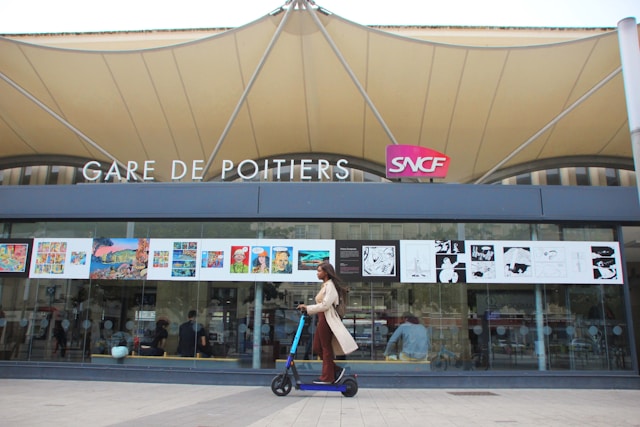
Poitiers station (Gare de Poitiers) is small, modern, and manageable. Walk off the TGV, follow signs for "Sortie" (exit), and you're in the station building with taxi rank visible ahead. The station sits just south of the medieval city centre - it's a pleasant 10-15 minute walk to the historic quarter, or €8-12 taxi ride if you have luggage.
Local buses run from the station forecourt to various Poitiers neighbourhoods (€1.30 ticket). Taxis wait outside. Car hire (Europcar, Enterprise, Hertz) available at the station if you're driving onwards to Futuroscope or the Vienne region.
Complete Journey Timings and Connections
Understanding the full journey timing from London to Poitiers is crucial for booking trains that connect properly and leaving enough buffer for delays.
Minimum Connection Time in Paris
The absolute minimum time between Eurostar arriving at Gare du Nord and TGV departing from Gare Montparnasse is 60 minutes if taking a taxi, or 75 minutes if taking the métro. This assumes everything goes perfectly - no delays, no queues, no mishaps.
I recommend allowing 90 minutes minimum for a relaxed connection. This gives you 30 minutes of buffer for Eurostar running late, longer-than-expected Paris transfer, or finding your TGV platform. If you miss your TGV, you'll need to buy a new ticket or pay fees to exchange (€10-60 depending on ticket type).
For peace of mind, allow 2 hours between trains. This lets you grab lunch in Paris, use proper toilets, buy snacks for the TGV, and board without stress. The extra hour makes the journey pleasant instead of anxious.
Sample Journey Timings
Fast Connection (Tight Schedule):
07:01 Eurostar departs London St Pancras
10:17 Arrive Paris Gare du Nord (Paris time: +1 hour)
10:20-11:00 Transfer to Gare Montparnasse (taxi)
11:40 TGV departs Paris Montparnasse
13:02 Arrive Poitiers
Total time: 5h 01m (London departure to Poitiers arrival)
Relaxed Connection (Recommended):
08:01 Eurostar departs London St Pancras
11:17 Arrive Paris Gare du Nord
11:20-13:10 Transfer plus lunch in Paris (1h 50m buffer)
13:58 TGV departs Paris Montparnasse
15:20 Arrive Poitiers
Total time: 6h 19m
Leisurely Connection (Maximum Comfort):
09:01 Eurostar departs London St Pancras
12:17 Arrive Paris Gare du Nord
12:20-15:30 Transfer plus proper lunch plus explore near Montparnasse (3h 10m)
15:52 TGV departs Paris Montparnasse
17:14 Arrive Poitiers
Total time: 7h 13m
Choose your connection time based on travel style. If you're experienced with European trains and travelling light, 90 minutes works. If it's your first time or you want a relaxed journey, allow 2-3 hours in Paris.
What to Do with Time in Paris
If you build in 2+ hours connection time, consider leaving Gare Montparnasse briefly. The station sits in the 14th/15th arrondissement with several nearby attractions within 10-15 minutes walk: Montparnasse Tower (€20 for 56th floor observation deck, stunning Paris views), Luxembourg Gardens (beautiful formal gardens, 20-minute walk), Catacombs of Paris (15-minute walk, though you'd need 90+ minutes to visit properly).
For shorter layovers, stay in the station area. Rue de Rennes (5-minute walk) has cafés and brasseries for proper sit-down lunch. Inside the station, Paul bakery does excellent sandwiches and pastries to take on the TGV.
Booking Tips and Prices
Getting the best prices on London-Poitiers train tickets requires booking early and understanding how French and British rail pricing works. Here's how to do it right.
When to Book
Eurostar tickets: Released 180 days (6 months) ahead. Prices start low and rise as departure approaches. Book 3-6 months ahead for best prices (from £52 return, or $72 USD). Booking 1-2 weeks before costs £120-200 return. Last-minute (48 hours) can hit £250+ return.
TGV tickets: Released 90-120 days ahead for most routes. SNCF releases different batches at different times, so check regularly. Prices start from €16-20 (£14-17, OUIGO) or €33-40 (£28-34, TGV INOUI) if booked 2-3 months ahead. Last-minute tickets cost €60-100+ (£51-85+).
Strategy: Book Eurostar first (further ahead), then book TGV once available. When booking TGV, look for trains that give you 90+ minutes connection in Paris. Don't stress about finding the absolute cheapest - the difference between booking 3 months and 2 months ahead is usually only £10-20, and waiting for the "perfect" price can backfire if cheap tickets sell out.
Where to Book
Eurostar.com: Best for Eurostar tickets. Direct from source, no booking fees, Club Eurostar points, easy management. Prices same as third-party sites but you get better customer service if things go wrong.
Trainline.com: Good for seeing all options at once - you can search London to Poitiers and it shows combinations of Eurostar plus TGV. Slight booking fee (£1-2) but interface is clearer than SNCF for British users. Handles both Eurostar and TGV in one transaction.
SNCF Connect (sncf-connect.com): Official SNCF site for TGV tickets. Sometimes has promotional fares not available elsewhere. Interface can be clunky for UK users, and payment can be finicky with UK credit cards. Worth checking for TGV-only bookings but Trainline is often easier.
Rail Europe: Third-party site that charges premium prices (usually £5-15 more than booking direct). Only advantage is customer service in English and guaranteed UK card acceptance. Skip unless other sites won't accept your card.
My recommendation: Book Eurostar on Eurostar.com. Book TGV on Trainline (easier) or SNCF Connect (sometimes cheaper). Total booking time: 10-15 minutes.
Ticket Prices Breakdown
Budget option (advance booking, OUIGO):
Eurostar Standard: £52-70 return
TGV OUIGO: €32-40 return (£27-34)
Total: £79-104 return
Mid-range (advance booking, standard service):
Eurostar Standard: £80-110 return
TGV INOUI 2nd class: €66-80 return (£56-68)
Total: £136-178 return
Comfort option (advance booking, better class):
Eurostar Plus: £120-150 return
TGV INOUI 1st class: €90-120 return (£76-102)
Total: £196-252 return
Last-minute (within 2 weeks):
Eurostar: £150-250 return
TGV: €80-140 return (£68-119)
Total: £218-369 return
For comparison, Ryanair Stansted-Poitiers costs £30-80 return for the flight alone, plus £30-60 checked luggage, £20-30 airport transport, €40-60 (£34-51) Poitiers airport transfer. Total: £114-221. The train is competitive, especially when booked ahead, and delivers you to the city centre.
Booking as a Package vs Separate Tickets
Some sites (Trainline, Rail Europe) let you book "London to Poitiers" as one transaction, automatically finding connecting trains. Others require separate bookings (Eurostar on Eurostar.com, TGV on SNCF).
Package booking advantages: One transaction, tickets delivered together, easier if things go wrong. Disadvantage: Less flexibility choosing connection times, sometimes packages force tight connections you'd rather avoid.
Separate booking advantages: Full control over trains and connection time, sometimes cheaper overall. Disadvantage: If Eurostar delays cause you to miss your TGV, you're liable for rebooking fees because tickets aren't connected.
I prefer separate bookings for the control, but allow 90+ minutes connection time to build in delay buffer.
Luggage Allowances and Rules
One huge advantage of trains over flying is luggage freedom. You're not paying extra, weighing bags, or fitting everything in a carry-on. Here's what you can take.
Eurostar Luggage Rules
Standard and Plus class: Two pieces of luggage up to 85cm long each, plus one piece of hand luggage (laptop bag, handbag, etc). No weight limit stated, but be reasonable. This equates to two large suitcases plus a daypack - far more generous than budget airlines.
Premier class: Three pieces of luggage up to 85cm each, plus hand luggage.
No liquid restrictions: Unlike airports, you can take full-size toiletries, drinks, even champagne in your luggage. Security will scan bags but you're not limited to 100ml containers. Pack your full skincare routine, bring wine from London to Paris, whatever you like.
Oversized items: Bikes, skis, and surfboards allowed with advance notification (email Eurostar customer service). Folding bikes in a bag count as normal luggage. Prams and wheelchairs travel free and don't count towards allowance.
Where luggage goes: Overhead racks (small bags), end-of-carriage luggage areas (large suitcases), or space behind the last row of seats. Luggage is not tagged or checked - you load it yourself and retrieve it at your destination. Keep valuables with you at your seat.
TGV INOUI Luggage Rules
No official limit on number or size of bags. The practical limit is what you can carry and what fits in storage spaces: overhead racks (small bags), space at the end of carriages (large suitcases), space between seat backs (medium bags). Most people travel with 1-2 suitcases plus hand luggage with no issues.
Like Eurostar, there are no liquid restrictions, no weight limits, no fees. Just bring what you need and store it sensibly on the train.
OUIGO Luggage Rules (More Restrictive)
Standard ticket includes: One cabin bag (55x35x25cm max) plus one small item (36x27x15cm - handbag, laptop bag). That's it. No checked luggage equivalent.
OUIGO staff do check bag sizes and will charge €30-40 at the gate if you show up with luggage that doesn't fit your ticket. For UK visitors connecting from Eurostar with normal holiday luggage, always book OUIGO Plus or just take TGV INOUI.
Luggage Tips for the Journey
Use wheeled suitcases - you'll be walking through stations and potentially up métro stairs in Paris. Keep one small bag with essentials (water, snacks, phone charger, book, medications) at your seat rather than in overhead storage. Label luggage with your name and UK mobile number. Don't pack anything irreplaceable in checked suitcases, though theft on European trains is rare. If changing trains in Paris, consider leaving a suitcase in left-luggage at Gare du Nord (€5-10 per bag for a few hours) if you want to explore the city without hauling everything to Montparnasse.
Food and Drink on Trains
One of the pleasures of train travel is eating and drinking properly, not airline pretzels and €5 sad sandwiches. Here's what to expect on each leg of the journey.
Eurostar Food and Drink
Standard class: No food included. Café Métropole bar carriage (usually carriage 5 or 13) sells sandwiches (£5-8), salads, crisps, chocolate bars, coffee (£2.80), soft drinks (£2-3), beer (£4-5), wine (£5-7 glass, £18-25 bottle). Quality is airport-level - fine but unremarkable. The baguette sandwiches are decent, coffee is acceptable, wine is drinkable but nothing special.
Eurostar Plus: Light meal included in ticket - typically a sandwich, small salad, dessert, and hot drink. Brought to your seat shortly after departure. Better quality than Standard class purchases but still modest portions.
Premier class: Three-course meal with drinks included. Menu changes seasonally. Breakfast service on morning trains, lunch on midday trains. Expect things like smoked salmon starter, chicken or fish main, cheese or dessert, plus wine, beer, or champagne. Quality is good - proper plated meals, not airline trays. Service is at-seat shortly after departure.
What I do: For Standard class, I grab coffee and a pastry at St Pancras (Pret, Paul, etc) to enjoy on the train, then buy lunch at Gare Montparnasse or bring my own. The Eurostar café is fine for coffee or a beer but not worth a full meal purchase.
TGV INOUI Food and Drink
2nd class: No food included. Voiture Bar (café car, usually carriage 5 or 15) sells hot and cold food: sandwiches (€5-8), salads (€6-9), snacks (€2-4), coffee (€2-3), beer (€4-5), wine (€5-8 glass, €15-25 bottle), spirits. The jambon-beurre (ham-butter baguette) is a French classic and perfectly good for €5. Coffee is espresso-machine quality. You can eat at the bar area or take food back to your seat.
1st class: Some TGV INOUI services offer "TGV à la carte" - pre-ordered meals delivered to your seat. Must book online when buying ticket or up to 4 hours before departure. Meals cost €10-18 and include hot dishes like quiche, pasta, or chicken with sides. Quality is significantly better than bar purchases. If not pre-ordered, 1st class passengers can still use the voiture bar same as 2nd class.
What I do: Grab a proper baguette sandwich from Paul bakery at Gare Montparnasse before boarding (€4-6, better quality and bigger than on-train sandwiches). Buy coffee on the train (€2-3). Alternatively, bring snacks from UK - trains have no food restrictions, so you can board with a Tesco meal deal, Pret salad, whatever you like.
OUIGO Food and Drink
No café car, no food service at all. You must bring your own food and drink. There's a vending machine on the platform at some OUIGO departure stations, but don't rely on it. Pack sandwiches, snacks, and water before boarding.
Alcohol Rules
You can drink alcohol on Eurostar and TGV. You can bring your own wine, beer, or spirits and consume it on board - nobody cares. There's no equivalent to airline rules about only drinking alcohol purchased on board. Common sense applies: don't get drunk and disorderly, but enjoying a bottle of wine over the journey is perfectly normal and accepted.
Water and Soft Drinks
Free tap water is available in train toilets (for handwashing) but bring your own drinking water. Buy a large bottle (1-1.5L) at St Pancras or Gare Montparnasse for £1-2 and stay hydrated throughout the journey. Train air conditioning can be drying, especially on long journeys. Soft drinks cost €2-3 on board, which is expensive for a Coke - buy before boarding if you want them.
Practical Information for UK Visitors
Final details that UK travellers need to know about taking the train from London to Poitiers.
Passports and Border Control
You need a valid UK passport with at least 3 months validity remaining. Since Brexit, UK citizens can stay in the Schengen area (includes France) for up to 90 days in any 180-day period without a visa. Your passport will be stamped on entry and exit, though stamps are not always consistent.
UK passport control and French border checks happen BEFORE boarding Eurostar at St Pancras. Once you arrive in Paris, you simply walk off the train - no queues, no checks. This is the beauty of the system. On return journeys, French exit checks and UK entry checks happen before boarding at Paris Gare du Nord.
Allow time for passport queues at St Pancras - they can be 10-20 minutes at peak times. Arrive 60 minutes before departure to be safe.
Phone and Data Roaming
Since Brexit, EU roaming is no longer guaranteed free for UK phone contracts. Check with your provider before travelling. Most major UK networks (EE, Vodafone, Three, O2) still include France in roaming packages, but some charge £2-5 per day or have data limits. Verify before departure or you could face surprise charges.
Free WiFi is available on Eurostar and TGV INOUI (though quality varies). Paris métro stations have free WiFi. Many cafés offer WiFi with purchase. Download offline maps (Google Maps, CityMapper) before travelling in case you lose connection.
Money and Cards
France uses the Euro. Exchange rates fluctuate but roughly £1 = €1.17-1.20 as of early 2026. Most UK debit and credit cards work throughout France with no issues. Contactless payment is widely accepted on trains, in stations, and in Paris. Some smaller cafés or shops may be cash-only.
Check if your bank charges foreign transaction fees (typically 2.5-3%). Consider a fee-free travel card like Revolut, Monzo, or Starling if you don't have one - they offer mid-market exchange rates with no fees.
ATMs are plentiful in Paris and Poitiers. Withdraw from bank ATMs (BNP Paribas, Société Générale, Crédit Agricole) rather than independent machines which charge higher fees.
Power Sockets and Charging
Eurostar uses UK three-pin sockets (Type G) - your normal UK plugs work throughout the train. TGV uses European two-pin sockets (Type C/E) - bring a European adapter (available for £3-5 at any travel shop or Boots). Both Eurostar and TGV INOUI have power at every seat or between seats. OUIGO charges €2 for power socket access - bring a fully charged power bank instead.
Time Zone
France is one hour ahead of UK time (GMT+1 vs GMT, or BST+1 vs BST). When Eurostar departure boards show arrival time in Paris, it's French local time. Remember to adjust your watch/phone. This matters for connection timings - if your Eurostar arrives Paris at 11:17 French time, that's 10:17 UK time.
Accessibility
Eurostar is fully accessible with wheelchair spaces on every train, assistance available at St Pancras (book 24 hours ahead via Eurostar customer service), and accessible toilets. TGV INOUI has wheelchair spaces and accessible facilities (book via SNCF Accès Plus service, 48 hours ahead recommended). Paris Gare du Nord and Montparnasse have lifts, but navigating Montparnasse métro station to mainline platforms requires a long walk even using lifts. If mobility is limited, strongly consider taxi over métro for Paris transfer.
Children and Families
Children under 4 travel free on Eurostar if sitting on an adult's lap (no seat). Ages 4-11 get reduced fares. Under-12s must be accompanied by someone 16+. TGV has similar rules: under-4s free on lap, ages 4-11 reduced fares. Both trains have baby-changing facilities in accessible toilets. Buggies/prams travel free and don't count towards luggage allowance. Family seating areas available on both Eurostar and TGV (request when booking). No kids' meals on standard class but bars sell crisps, fruit, snacks children like.
Pets
Small pets in carriers (max 6kg total) travel on Eurostar for £20 each way. Must stay in carrier throughout journey. TGV allows small pets in carriers for €7 each way, larger dogs on leads and muzzled for €20-40 depending on route. Guide dogs travel free on both. Book pet travel in advance - spaces limited.
What to Do if Things Go Wrong
Eurostar delayed causing missed TGV connection: If you booked as one through-ticket, you're entitled to travel on next available TGV at no extra cost. If separate bookings, you're liable for new ticket or exchange fee (€10-60 depending on ticket type). This is why I recommend 90+ minutes connection time.
Lost or stolen tickets: Eurostar e-tickets can be reprinted from confirmation email or Eurostar account. TGV e-tickets similar via SNCF account. If you've lost everything, go to ticket desk with ID and booking reference - they can usually help.
Medical emergency or urgent travel: Both Eurostar and TGV INOUI offer some flexibility for genuine emergencies (death in family, serious illness). Contact customer service with documentation. Refunds or exchanges may be possible outside normal terms.
Train strikes: France has occasional rail strikes. If your TGV is cancelled, SNCF must rebook you on next available train or offer full refund. Check SNCF website 24-48 hours before travel during strike-prone periods (typically autumn). Eurostar is less affected by French strikes but does occasionally have UK-side disruptions.
Final Tips from Experience
Download tickets to phone and email them to yourself as backup. Arrive at St Pancras 60 minutes before departure, not 30. Bring snacks and water - stations are expensive. If you're nervous about Paris transfer, allow 2 hours and take a taxi. The journey gets easier every time you do it. Within a couple of trips, London to Poitiers will feel like a comfortable routine rather than an adventure.
The London to Poitiers train route is one of Europe's finest journeys. You're connecting two wonderful cities via the heart of France, travelling at 300 km/h through beautiful countryside, eating proper food, drinking wine if you fancy it, and arriving refreshed in Poitiers city centre ready to explore. Give it a try. After the first journey, you'll wonder why anyone still flies this route.
Photo de pony sur Unsplash