
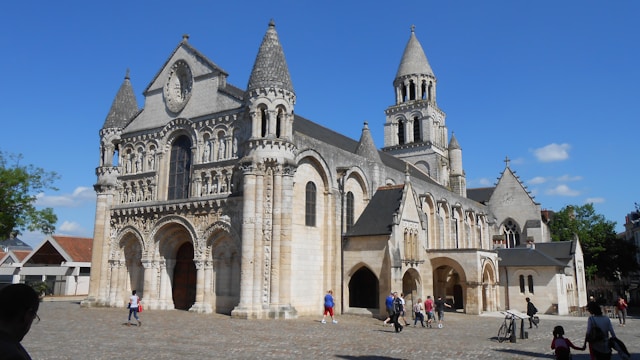
Standing in Poitiers’ main square facing Notre-Dame-la-Grande for the first time, you understand immediately why Romanesque architecture matters. The façade isn’t just decorative—it’s a 12th-century comic book carved in stone, telling the entire Christian salvation story from Adam and Eve through to Christ in Glory, all compressed onto a wall barely 15 metres wide. Every apostle, every biblical scene, every symbolic detail was placed deliberately to teach medieval congregations who couldn’t read.
Nine hundred years later, it still works. This isn’t Chartres or Notre-Dame de Paris—grand Gothic cathedrals that dominate their cities. Notre-Dame-la-Grande sits modestly in a pedestrian square surrounded by cafés, utterly accessible, human-scaled, free to enter. You can walk past it daily and still notice new details each time: a grimacing modillon here, an intertwined beast there, Joseph looking perplexed at the Nativity scene. British visitors familiar with Durham or Canterbury’s Romanesque architecture will recognize the rounded arches and solid proportions, but Poitiers’ approach is distinctly different—exuberantly sculptural where English Romanesque tends toward austere grandeur. The church delivers two completely different experiences depending when you visit.
By day, the golden limestone glows in sunlight, revealing intricate carvings that reward close inspection. After dark in summer, the Polychromies light show transforms the façade into a riot of medieval colour—lapis lazuli blues, vermillion reds, gold leaf brilliance—recreating how the church actually looked when newly completed in 1130. Most UK cathedrals charge £8-15 entry and close by 6pm. Notre-Dame-la-Grande is free, always accessible from outside, and delivers its most spectacular show at 10:30pm on summer evenings. This guide explains what makes Notre-Dame-la-Grande special, how to read the façade’s sculptural program, when to catch the summer light show, what the recently restored interior contains, and why spending 30 minutes here provides more medieval art education than most museum visits.
Quick Navigation
Why Notre-Dame-la-Grande Matters
Notre-Dame-la-Grande represents Poitevin Romanesque architecture at its peak—a regional style that developed independently from the massive Cluniac churches of Burgundy or the austere Norman Romanesque that shaped English cathedrals after 1066. While Durham Cathedral impresses through sheer scale and engineering ambition, Notre-Dame-la-Grande achieves its impact through concentrated sculptural richness on a more intimate scale. What Makes It Exceptional:The Façade-Screen Concept: The entire western front is a façade-screen—a flat decorative wall applied to the actual church structure, rising significantly higher than the building behind it to create dramatic visual impact. This theatrical approach, characteristic of Poitevin Romanesque, transforms the façade into a stage set for biblical storytelling. Sculptural Density: Every available surface carries carving—historiated capitals showing biblical scenes, geometric patterns, fantastical beasts, grimacing modillons (corbels), intertwined foliage. The density of decoration exceeds most Romanesque churches. Where English Romanesque often emphasizes bold geometry and restrained ornament, Poitevin Romanesque revels in exuberant surface covering. Iconographic Completeness: The façade presents a complete theological program celebrating the Virgin Mary’s role in Christian salvation, from the Fall (Adam and Eve) through the Incarnation (Annunciation, Nativity) to the Second Coming (Christ in Glory). Everything connects—no random decoration. State of Preservation: Despite Huguenot vandalism in 1562 (when Protestant iconoclasts beheaded many figures), 17th-century salt damage from adjacent merchants’ shops, and centuries of weathering, the façade survived remarkably intact. The 1992-1995 restoration cleaned and stabilized the stonework, revealing traces of the original polychrome paint that once covered every surface. UK Architectural Context: British visitors familiar with Romanesque architecture will find both similarities and striking differences:
- Durham Cathedral (1093-1133): Built simultaneously with Notre-Dame-la-Grande’s façade, but Durham emphasizes soaring height, engineering innovation (earliest pointed arches in Europe), and austere grandeur. Notre-Dame-la-Grande prioritizes rich surface decoration over structural daring.
- Canterbury Cathedral (Romanesque portions): The Norman crypt (1070s-1090s) shows restrained carved capitals. Notre-Dame-la-Grande’s capitals explode with narrative detail.
- Ely Cathedral (1080s-1140s): Demonstrates English Romanesque’s preference for bold arcading, minimal figure sculpture, geometric ornament. Notre-Dame-la-Grande covers every surface with figures and stories.
The fundamental difference: English Romanesque, shaped by Norman architectural culture, emphasized structural clarity, monumental scale, and geometric pattern. Poitevin Romanesque, influenced by Aquitanian culture and pilgrimage routes to Santiago de Compostela, prioritized sculptural storytelling and decorative richness.
The Façade: Reading the Medieval Comic Book
Approaching Notre-Dame-la-Grande from the square, you face a sculptural program designed to be read from bottom to top, left to right, like a medieval manuscript. Every element carries meaning. Here’s how to decode it.
Ground Level: The Biblical Frieze
Above the entrance portal, a horizontal band (frieze) narrates the Christian story from Creation to Christ’s birth. Stand directly in front and read left to right: Left Side (Old Testament):
- Adam and Eve: The Fall. Eve hands Adam the forbidden fruit. An inscription reads: “The crime of Eve brings to Man the origin of his affliction.” This sets up the narrative—humanity needs salvation.
- Nebuchadnezzar II: King of Babylon, representing earthly power and Old Testament kingdoms.
- Four Prophets: Daniel, Moses, Isaiah, Jeremiah (identified by attributes). Medieval theology saw these prophets as foretelling Christ’s coming, bridging Old and New Testaments.
Right Side (New Testament):
- The Annunciation: Angel Gabriel announces to Mary she will bear God’s son. This is the moment of Incarnation—God becoming human.
- The Visitation: Pregnant Mary visits her cousin Elizabeth (pregnant with John the Baptist).
- The Nativity: Mary reclines with the infant Jesus. Ox and ass warm the baby with their breath (detail from apocryphal gospels).
- The Bathing of Christ Child: Midwives bathe the newborn Jesus. A eucharistic cup appears—foreshadowing Christ’s Passion and the Mass.
- Perplexed Joseph: Mary’s husband looks confused. Medieval audiences found this humanizing detail amusing—Joseph wasn’t sure what to make of the virgin birth.
Why This Matters: The frieze presents salvation history as linear narrative—Fall creates problem, Incarnation provides solution. Every medieval person understood this story framework.
Middle Level: The Apostolic Church
Two tiers of blind arcades (decorative arches) contain standing figures: Twelve Apostles: Christ’s disciples, representing the foundation of the Church. Each holds a book or scroll—they carry Christ’s teaching to the world. Two Bishops: Local tradition identifies them as St. Hilary of Poitiers (4th-century theologian, Doctor of the Church) and St. Martin of Tours (soldier-turned-monk who evangelized Gaul). These figures connect universal Church (Apostles) to local Poitevin religious identity. Architectural Detail: The arcades create rhythm and order, containing the narrative energy of the frieze below. The repetition of identical arch forms emphasizes the Apostolic succession—unified teaching passed through generations.
Top Level: Christ in Glory (The Parousia)
The triangular gable (pediment) shows the Second Coming: Central Figure: Christ stands in a mandorla (almond-shaped glory), right hand raised in blessing. He’s surrounded by clouds and stars—the vault of heaven. The Tetramorph: Four symbols of the Evangelists surround Christ:
- Winged man (Matthew)
- Winged lion (Mark)
- Winged ox (Luke)
- Eagle (John)
These creatures derive from Ezekiel’s vision and Revelation—they represent the fourfold Gospel witness. Sun and Moon: Flank Christ, representing all creation acknowledging the Creator. Theological Meaning: The gable shows the endpoint of salvation history—Christ returning in glory to judge the living and dead. The façade thus presents complete narrative arc: Fall → Incarnation → Church → Second Coming.
Decorative Elements Worth Noticing
Modillons (Corbels): The roofline features carved corbels—grotesque faces, beasts, acrobats. Some grimace, some stick out tongues, some perform impossible contortions. These aren’t random—they represent sin, chaos, evil literally pushed to the margins of the sacred space. Capitals: Column capitals show intricate foliage, intertwined beasts, geometric patterns. Look for:
- Acanthus leaves (classical motif)
- Interlaced vines (representing Tree of Life)
- Fighting beasts (good vs. evil struggle)
Pine Cone Turrets: The two towers flanking the façade terminate in distinctive cone-shaped roofs covered with stone scales. This became a signature feature of Poitevin Romanesque, copied across the region.
The Polychromies Light Show
The single most spectacular way to experience Notre-Dame-la-Grande costs nothing, requires no booking, and happens every summer evening at approximately 10:30pm (dusk). The Polychromies—a son et lumière (sound and light) show created by artist collective Skertzò—transforms the pale limestone façade into a riot of medieval colour.
What It Is
During the 1992-1995 restoration, conservators discovered traces of paint on the façade—tiny fragments of pigment trapped in crevices, protected from centuries of weathering. Analysis revealed the façade was originally painted in vivid colours: lapis lazuli blue, vermillion red, ochre yellow, gold leaf highlights. Like all medieval churches, Notre-Dame-la-Grande was a polychrome explosion, not the monochrome stone we see today. Skertzò used these archaeological traces to imagine seven different colour schemes the façade might have worn at various points in its history. The Polychromies project these schemes onto the stone in sequence, each lasting about 2 minutes, cycling through the complete program in roughly 15 minutes before repeating.
The Seven Colour Schemes
- Minérale (Mineral): Natural stone tones, earth pigments—how the façade looks today
- Végétale (Vegetal): Greens and earth tones emphasizing organic patterns
- Marie: Blues and golds celebrating the Virgin Mary (church’s patron)
- Radegonde: Warm reds and golds honoring St. Radegonde, Poitiers’ patron saint
- Byzantine: Rich purples, golds, intense blues inspired by Byzantine mosaics
- Lapis-Lazuli: Deep ultramarine blue (lapis lazuli was medieval painting’s most expensive pigment, worth more than gold)
- Pur Pigment (Pure Pigment): Saturated primary colours showing maximum medieval colour intensity
Why It’s Worth Seeing
Historical Accuracy: This isn’t arbitrary modern art projection—it’s archaeological reconstruction based on scientific analysis. Seeing the façade in colour reveals how medieval congregations actually experienced it. Sculptural Detail: The projected colours highlight sculptural details invisible in daylight. Shadows deepen, figures pop forward, the biblical frieze becomes easier to read. You suddenly understand compositional relationships that seem flat in monochrome stone. Atmosphere: The square fills with locals and tourists sitting on café terraces, on the church steps, standing in groups. Children run around, couples hold hands, everyone watches together. It’s communal, free, relaxed—very French evening entertainment. UK Comparison: Similar light shows at UK cathedrals (Durham’s Lumiere, Canterbury projections) are occasional special events. Poitiers does this every single summer evening, free, no ticketing, no crowds control. Just turn up.
Practical Details
When: Every evening from late June through early September (exact dates vary yearly, typically June 21 – September 15). Also during Christmas holidays (mid-December through early January). Time: Show begins at nightfall—approximately 22:30 (10:30pm) in late June/early July, slightly earlier (22:00-22:15) by late August/September as nights darken sooner. Duration: Complete cycle runs about 15 minutes, then repeats. Most people watch one complete cycle (15 minutes) or stay for two cycles (30 minutes). Where to Stand: Anywhere in Place Charles de Gaulle (the square facing the church). Best viewing: center of the square, about 20-30 metres back from the façade—far enough to see the whole composition without craning your neck. Arrival: Come 15-20 minutes early to claim a good spot if visiting in peak summer (July-August). Off-peak (June, September) you can arrive 5 minutes before. What to Bring: Nothing required. Some people bring folding chairs or sit on church steps. Surrounding cafés remain open—you can watch while having dinner/drinks on a terrace. Important Note (2024-2027): Notre-Dame-la-Grande’s interior closed for restoration in November 2024 and will remain closed until 2027. However, the Polychromies light show continues throughout this period—the façade remains accessible and the summer projections proceed as normal.
Inside the Church
Current Status: The church interior is closed for major restoration work from November 2024 through 2027. When it reopens, visitors will find:
Romanesque Frescoes (Choir Vault)
The apse vault above the choir preserves rare Romanesque frescoes from around 1100, predating the façade. These paintings survive because the vault’s curve protected them from later renovations that destroyed wall paintings elsewhere. What You See:
- Virgin and Child in Mandorla: Central image showing Mary holding infant Jesus, surrounded by almond-shaped glory
- Christ in Majesty: On the vault, Christ enthroned between circle and square (representing heaven and earth)
- Lamb of God: Within a circle, symbolizing Christ’s sacrifice
- Twelve Apostles: Seated under arches around the apse, mirroring the façade’s apostle figures
- Angels: In corner positions, guiding souls to paradise
Art Historical Significance: These frescoes may have served as the model for the façade sculptures—the attitudes, compositions, even specific poses match between painting and carved stone. This suggests the sculptors worked from existing interior paintings when designing the exterior program. Style: Hieratic (formal, frontal, non-naturalistic), with bold outlines and flat color areas characteristic of Romanesque painting. Similar in approach to contemporary English Romanesque painting (St. Albans Psalter, Winchester Bible illuminations).
19th-Century Interior Decoration
In 1851, restorer Joly-Leterme repainted the nave, columns, and vaults with “Romano-Byzantine” motifs—geometric patterns, stylized foliage, rich colours inspired by medieval precedents but executed in mid-Victorian taste. This was standard 19th-century restoration practice (think Viollet-le-Duc’s work at French cathedrals). Modern art historians consider this over-restoration, but it creates striking visual impact. The painted columns and vaults give some sense of medieval churches’ original polychrome interiors, even if the specific patterns are Victorian inventions.
Other Interior Features
- Baroque Pulpit (17th century): Elaborately carved wooden pulpit from the convent period
- Bronze Lecterns (16th century): Two substantial lecterns for reading scripture
- Statue of Our Lady of the Keys (late 16th/early 17th century): Hieratic style deliberately recalling Romanesque aesthetics, replacing the miraculous statue destroyed by Huguenots in 1562
- Stained Glass (19th-20th centuries): All windows are modern replacements—the Huguenots destroyed medieval glass
- Organs: Small choir organ (late 19th century), large organ (1996)
History & Architecture
Origins and Construction
10th Century: First documented mention as “Sancta Maria Maior” (Holy Mary the Greater). A Romanesque church stood on this site, probably replacing an earlier structure. Legend claims Roman emperor Constantine founded the church, though no archaeological evidence supports this. Late 11th Century (1080s): Complete rebuilding in High Romanesque style. Church consecrated in 1086. This is the building whose core structure survives today. Early 12th Century (~1100-1130): Major expansion: two bays added to extend the nave westward, original façade demolished, new façade-screen constructed. The sculptural program completed around 1130. This is the façade we see today. 15th-16th Centuries: Wealthy Poitevin merchant families funded private chapels added along the north side of the nave—six chapels total, each endowed by a different family for their exclusive use and burial.
Damage and Restoration
1562 – Huguenot Sack of Poitiers: Protestant iconoclasts broke the heads off most façade figures, considering them idolatrous. Many sculptures lost their faces—you can still see the damage. Fortunately, bodies and architectural framework survived, and some heads were recarved in later restorations. 17th Century: Salt merchants established shops against the façade. Salt contamination damaged the limestone, causing deterioration that worsened over subsequent centuries. 1840: Classified as Monument Historique (Historic Monument), providing legal protection and state funding for maintenance. 19th Century: Multiple restoration campaigns. Joly-Leterme’s 1851 repainting of interior most significant. Various façade consolidations attempted with mixed success. 1992-1995 – Major Restoration: Comprehensive campaign: stones removed, desalinated in laboratory, cleaned, stabilized, reinstalled. Façade inauguration in 1995 coincided with creation of first Polychromies light show. This restoration revealed paint traces that informed the light show’s colour schemes. 2024-2027 – Current Restoration: Interior closed for structural repairs, roof work, and conservation of frescoes and painted decoration. Façade remains accessible, Polychromies continue.
Architectural Features
Plan: Latin cross with very short transept (barely projecting beyond nave width). Three-aisle basilica plan—central nave flanked by side aisles of nearly equal height, creating hall-church effect characteristic of Poitevin Romanesque. Roofing: Barrel vault over nave, groin vaults over aisles. The wide nave vault required thick walls and small windows—typical Romanesque structural logic. Choir: Apse with ambulatory (walkway) and radiating chapels, built partially over a crypt. This pilgrimage church design allowed crowds to circulate around relics without disrupting services. Towers: Two cylindrical towers flank the façade, capped with distinctive pine-cone roofs covered in stone scales. These conical roofs became iconic of Poitevin Romanesque—you see them copied across the region.
The Legend of the Keys
Every city with a major medieval church has its miracle legend. Notre-Dame-la-Grande’s legend of the keys combines local patriotism, Marian devotion, and historical fiction in ways medieval audiences loved.
The Story
In 1202, English forces besieged Poitiers. The mayor’s clerk, corrupted by greed, promised to betray the city to the English for a large sum of money. He would steal the city keys and deliver them on Easter Day. On the night before Easter, the clerk crept into the mayor’s chamber to steal the keys—but they had vanished. The next morning, the mayor discovered the theft attempt and the missing keys. In desperation, he went to Notre-Dame-la-Grande to pray for divine intervention. Looking up at the statue of the Virgin Mary, he saw her holding the keys. She had taken them to prevent betrayal. That same night, the Virgin Mary, St. Hilary, and St. Radegonde appeared before the English army camped outside Poitiers’ walls. Terrified by these supernatural apparitions, the English soldiers panicked, killed each other in confusion, and fled. Poitiers was saved by the Virgin’s intervention.
Historical Problems
The legend is demonstrably false on multiple counts: Political Reality: In 1202, Poitou was part of the English Duchy of Aquitaine under Henry II and Eleanor of Aquitaine. Poitiers was an English possession—there would be no English siege of their own city. No Contemporary Evidence: No 1202 chronicles mention any siege, betrayal attempt, or miracle. First Appearance: The earliest written version appears in Jean Bouchet’s Annals of Aquitaine (1524)—over 300 years after the supposed events.
Why the Legend Developed
The legend probably emerged during the Hundred Years’ War (14th-15th centuries) when Poitiers was repeatedly contested between French and English forces. The “1202” date backdated the legend to give it greater antiquity and authority. The legend gained renewed popularity after 1569 when Huguenot forces under Admiral Gaspard II de Coligny threatened Poitiers. Catholics invoked the Virgin’s miraculous protection, and the city successfully resisted Protestant siege. From 1569 until 1887, Poitiers celebrated the miracle with an annual procession through the city on Easter Monday.
Commemoration Today
Inside the church (when open):
- 19th-century stained glass window depicting the legend
- 17th-century painting showing the Virgin holding the keys
- 19th-century statue of Our Lady of the Keys in central position
The legend, though historically false, reveals important truths about medieval devotion, local identity, and how communities created origin myths to explain their survival through crises.
Visiting: Practical Information
Location and Access
Address: Place Charles de Gaulle, Poitiers city centre From Train Station: 10-minute walk downhill. Exit Gare de Poitiers-Ville, walk south on Boulevard du Grand Cerf, continue onto Rue Carnot, church visible ahead in the square. From Hotels: All central Poitiers hotels within 5-10 minutes walk. The church occupies the city’s main square—you can’t miss it. Parking: Public car parks nearby:
- Parking Hôtel de Ville (2 minutes walk, €2/hour, €12/day)
- Parking Notre-Dame (3 minutes walk, €2/hour, €12/day)
Street parking limited to 2 hours in centre. If visiting for Polychromies in evening, arrive after 7pm when street parking becomes free.
Opening Hours and Entry
Exterior/Façade: Always accessible—it faces a public square. View anytime, day or night. Interior: CLOSED for restoration November 2024 – 2027. When it reopens, typical hours will be:
- Daily 9:00-19:00 (summer)
- Daily 9:00-18:00 (winter)
- May close during services
Entry Fee: FREE (when open). This is a functioning parish church, not a museum.
Polychromies Light Show
Dates: Every evening late June – mid September (exact dates vary yearly, typically June 21 – September 15). Also Christmas holidays (mid-December – early January). Time: Begins at nightfall (approximately 22:00-22:30 depending on season) Duration: 15-minute cycle, repeats continuously Cost: FREE Booking: Not required—just turn up
Guided Tours
Poitiers Tourist Office (Office de Tourisme Grand Poitiers) offers guided tours: Group Tours: Year-round, various themes including Romanesque architecture, medieval Poitiers Family Tours: Child-adapted visits during school holidays Private Tours: Can be arranged for small groups Booking: Grand Poitiers Tourist Office, Place Charles de Gaulle (literally next to the church) Cost: €6-8 per person for group tours Language: Mostly French, occasional English tours in summer—check with tourist office
Photography
Exterior: Unrestricted. The façade is a public monument in a public square—photograph freely. Interior (when open): Usually permitted without flash. Respect services in progress. Polychromies: Photography encouraged. Bring tripod for long exposures if you want sharp night shots.
How Much Time to Allocate
Quick Visit (Façade Only): 15-20 minutes
- Stand back to admire composition (2 minutes)
- Move close to examine biblical frieze details (5 minutes)
- Look up at apostles and Christ in Glory (3 minutes)
- Circle to see north and south portals (5 minutes)
Thorough Visit (Façade + Polychromies): 45 minutes – 1 hour
- Daytime façade examination (20 minutes)
- Return for Polychromies in evening (watch one complete 15-minute cycle, or stay for two cycles = 30 minutes)
Complete Visit (Façade + Interior + Polychromies, when interior reopens): 1.5 hours
- Façade (20 minutes)
- Interior (30 minutes including Romanesque frescoes, painted decoration, furnishings)
- Polychromies evening show (30 minutes for two cycles)
Combining with Other Poitiers Sites
Notre-Dame-la-Grande sits in the historic centre surrounded by other major monuments: Within 5 Minutes Walk:
- Palace of Poitiers (Palais de Justice) – medieval ducal palace, now law courts
- Covered market (Les Halles) – 19th-century iron market hall
- St-Porchaire Church – another Romanesque gem
- Medieval pedestrian streets (Rue de la Regratterie)
Within 10 Minutes Walk:
- St-Pierre Cathedral – imposing Gothic cathedral with magnificent 12th-century stained glass
- Baptistery of St-Jean – one of France’s oldest Christian buildings (4th century)
- Sainte-Radegonde Church – Romanesque church with crypt containing St. Radegonde’s tomb
See our complete Poitiers city guide for walking routes connecting these monuments.
Accessibility
Exterior/Façade: Fully accessible—level pedestrian square Interior (when open): Ground floor accessible, but no elevator to upper levels or crypt
Nearby Facilities
Cafés and Restaurants: Dozens surround the square. Good options for watching Polychromies while dining on terraces. Public Toilets: In Les Halles covered market (2 minutes walk) Tourist Office: Place Charles de Gaulle (next to church)—maps, brochures, tour bookings
Final Verdict
Notre-Dame-la-Grande delivers concentrated medieval art education in 15-30 minutes, costs nothing, and requires zero advance planning. For UK visitors familiar with Durham’s austere Norman Romanesque or Canterbury’s grand Gothic, it offers a completely different architectural approach—exuberant, theatrical, story-driven rather than engineering-focused. Why It’s Worth Your Time:Educational Value: You learn more about Romanesque sculptural programs here than in most museum visits. The façade is a textbook in stone—every element explicable, every detail meaningful. Spending 20 minutes with a guidebook (or this article) teaches you how to read medieval churches. Accessibility: Free, always visible, right in the city centre. No tickets, no queues, no restricted viewing times. Durham Cathedral charges £10, Canterbury £12.50, both close at 5-6pm. Notre-Dame-la-Grande is free 24/7. The Polychromies: Genuinely spectacular and unique. Similar light shows at UK cathedrals happen once or twice a year as special events. Poitiers does this every summer evening, free. The archaeological accuracy makes it educational, not just pretty—you see how medieval congregations actually experienced their churches. Human Scale: This isn’t overwhelming like massive Gothic cathedrals. It’s approachable, detailed, rewards close looking. You can examine individual carvings without binoculars. UK Comparison Worth Making: A British visitor spending equivalent time at Durham and Notre-Dame-la-Grande learns:
- Durham: Romanesque structural innovation (ribbed vaults, pointed arches), massive scale engineering, Norman ecclesiastical power, geometric decoration
- Notre-Dame-la-Grande: Romanesque narrative sculpture, theological iconography, regional style variation, medieval polychromy, Aquitanian culture
Both are world-class. Neither substitutes for the other. If you care about medieval architecture, Notre-Dame-la-Grande is essential—it represents a completely different strand of Romanesque development. When to Visit:Ideal: Summer evening. Examine the façade in late afternoon daylight (5-7pm), have dinner at a square-side café, stay for the Polychromies at 10:30pm. This gives you both detailed daytime inspection and spectacular nighttime colour—complete experience in one evening. Also Good: Morning visit (9-11am) when golden sunlight hits the façade from the east, creating strong shadows that emphasize sculptural depth. Skip: Midday (harsh overhead light flattens details). Rainy days (wet stone looks grey and murky). Honest Assessment: Notre-Dame-la-Grande won’t change your life. It’s not the Sistine Chapel or Chartres Cathedral—those are sui generis masterpieces that transcend their categories. This is an exceptionally fine example of a specific regional Romanesque style, beautifully preserved, intelligently presented, and entirely free to experience. If you’re spending 2-3 days in Poitiers for Futuroscope or exploring the region, allocate 30 minutes for Notre-Dame-la-Grande. If you have any interest in medieval art, Romanesque architecture, or sculptural storytelling, make it an hour and return for the Polychromies. It’s the best free cultural experience in Poitiers, and one of the finest Romanesque façades in France. That’s more than enough reason to visit.