The Marais Poitevin is France’s hidden masterpiece of water and wilderness. Known as the “Venise Verte” (Green Venice), this vast wetland stretches across three French departments creating an extraordinary labyrinth of tree-lined canals, flat-bottomed boats gliding silently through duckweed-covered waterways, medieval abbeys rising from marshland islands, and 112,000 hectares of protected nature that feel like nowhere else in Europe. It’s the second-largest wetland in France after the Camargue, but infinitely more mysterious and intimate.
For British visitors based in La Rochelle, the Marais Poitevin makes a perfect day trip or overnight escape. Just 25-60 minutes by car depending on which village you choose, you’ll find yourself in a completely different world – one where ash trees arch over still green water, traditional barques (flat-bottomed boats) are punted through narrow channels using long poles called pigouilles, and villages with stone houses and flower-filled gardens emerge from the marsh like something from a medieval romance. This isn’t manicured tourism; it’s authentic rural France with an ecosystem so rich and rare it’s protected as both a Regional Natural Park and a Grand Site de France.
This complete guide tells you everything UK visitors need to know about experiencing the Marais Poitevin. I’ll show you which villages to visit, where to take the best boat tours, how to cycle through 850km of flat waterside paths, what wildlife you’ll encounter, and all the practical details for visiting from La Rochelle. Whether you want a peaceful morning gliding through green canals, a full day cycling and boating, or an overnight stay immersed in marsh life, here’s how to discover France’s Green Venice.
Quick Navigation
What is the Marais Poitevin (Green Venice)
The Marais Poitevin is a 112,000-hectare wetland in western France, spanning three departments: Vendée, Deux-Sèvres, and Charente-Maritime. It’s the second-largest wetland in France after the Camargue, but where the Camargue is open, sun-blasted, and salty, the Marais Poitevin is intimate, shaded, and freshwater. Think Louisiana bayou meets Venice, minus the alligators and tourists, with French medieval villages scattered through it.
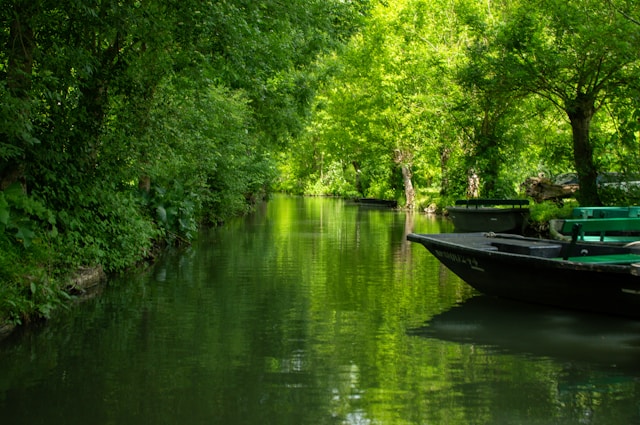
The marsh has three distinct zones. The Marais Mouillé (wet marsh), known as the Green Venice, is the heart – a dense network of tree-shaded canals where you travel by boat through what feels like a green cathedral of overhanging ash and poplar branches. The water is still, dark green with duckweed, and utterly silent except for birdsong and the soft splash of a boat pole. This is the zone everyone comes to see, centered around villages like Coulon, Arçais, and La Garette.
The Marais Desséché (dry marsh) is reclaimed agricultural land – flat wheat fields, sunflower crops, and grazing cattle where monks drained the medieval wetlands. Less visually dramatic but essential to the ecosystem. The Marais Maritime (maritime marsh) along the coast is tidal marshland where the Sèvre Niortaise river meets the Atlantic, creating salt marsh habitat with different bird species and a completely different character.
The marsh exists because Benedictine monks drained the medieval Gulf of Pictons (Golfe des Pictons) starting in the 10th century. Five major abbeys – Maillezais, Saint-Michel-en-l’Herm, Nieul-sur-l’Autise, Luçon, and Fontenay – coordinated massive drainage projects, digging canals to turn unusable swamp into productive farmland. The canal system they created is still visible today, with over 8,000 kilometres of waterways crisscrossing the marsh. Dutch engineers refined the system in the 17th century, adding locks and gates to control water levels.
The result is a landscape that’s neither fully land nor fully water, but something in between. Locals call the narrow tree-shaded canals “conches.” The traditional boats are barques – flat-bottomed wooden punts pushed with a long pole (pigouille). Houses in the wet marsh were built on slightly raised ground with vegetable gardens accessible only by boat. It’s a way of life that’s persisted for centuries, though tourism now supports what farming once did.
The marsh was designated a Regional Natural Park (Parc Naturel Régional du Marais Poitevin) in 1979 and earned Grand Site de France status in 2010, protecting it from overdevelopment while allowing sustainable tourism. About 1.4 million visitors come annually, mostly French, making it far less crowded than major tourist sites but busy enough in peak summer months (July-August) that booking boat tours ahead helps.
UK comparison: Think the Norfolk Broads meets Stratford-upon-Avon’s canals, but with medieval abbeys, better food, and an ecosystem five times richer. The silence and stillness are extraordinary – this is genuinely one of France’s most peaceful destinations.
Best Villages to Visit in the Marais Poitevin
The Marais Poitevin is dotted with picturesque villages, each offering boat access to different parts of the marsh. Here are the best for UK visitors, with practical details for each.
Coulon: Capital of the Green Venice
Coulon is the main tourist hub and deservedly so. This “Petite Cité de Caractère” (Small Town of Character) sits in the heart of the wet marsh with three boat landing stages along Quai Louis Tardy, making it the easiest village for first-time visitors. The village itself is charming: narrow stone streets, flower-filled window boxes, stone houses with blue shutters, and enough restaurants and cafés to make lunch easy.
The Maison du Marais Poitevin (House of the Marais Poitevin) is here – a museum explaining the marsh’s history, ecology, and traditional life. Adult entry €5 (£4.20), worth visiting before your boat ride to understand what you’re seeing. The 11th-century Church of the Holy Trinity is also worth a quick look.
Boat hire in Coulon: multiple operators along the quay offer guided tours (€12-18/£10-15 per person for 45-90 minutes) or self-hire barques (€15-25/£13-21 per hour depending on boat size). Canoes also available (€12-18/£10-15 per hour). Parking is easy (free car parks 5 minutes’ walk from quay), facilities are good (toilets, cafés, tourist office), and signage is clear.
Downsides: Coulon can feel crowded in July-August, especially weekends. If you want authentic marsh solitude, come May-June or September, or visit a quieter village.
Arçais: The Beautiful Alternative
Arçais is smaller, quieter, and arguably more picturesque than Coulon. The village sits on a curve of the Sèvre Niortaise with a beautiful church, stone bridge, and tree-shaded embarkation point. Fewer tourists mean more authentic atmosphere – you’ll see locals fishing, gardens planted right to the water’s edge, and traditional marsh life still visibly functioning.
Boat hire available at the main embarcadère (similar prices to Coulon: guided tours €12-18/£10-15, self-hire €15-25/£13-21 per hour). The marsh routes from Arçais tend to be narrower and more densely canopied than Coulon’s main channels – perfect if you want the full “green cathedral” experience. Less infrastructure means fewer cafés, but there’s a good restaurant (La Venise Verte) and a small boulangerie for picnic supplies.
Visit Arçais if you want quieter water, fewer boats, and more authentic marsh character. Skip if you need extensive facilities or want guaranteed availability without booking ahead.
La Garette: Tranquil and Unspoiled
La Garette (also called Sansais-La Garette) is the quietest main village, perfect for escaping crowds entirely. The embarkation point is Embarcadère des Frênes on Rue des Gravées, a gorgeous tree-lined canal street that feels like stepping into a painting. The village itself is tiny – a handful of houses, no real centre – but the marsh access is superb.
Guided tours from €15/£13 per person (book ahead as fewer operators than Coulon/Arçais). Self-hire available but limited boats. The water routes from La Garette are among the most beautiful in the marsh – narrow conches under arching trees, traditional vegetable gardens on marsh islands, genuinely wild-feeling sections where you might be the only boat for hours.
Camping L’Îlot du Chail is canalside here if you want to stay overnight in the heart of the marsh. No restaurants in La Garette itself (bring picnic or drive to Coulon/Arçais), minimal facilities, but maximum tranquility. Visit if you prioritize peace over convenience.
Damvix: Village Charm with Easy Access
Damvix sits 5km from Arçais with good boat access and more village character than La Garette but less tourist infrastructure than Coulon. The embarcadère “La Grenouille Bleue” (The Blue Frog) offers guided tours and rentals. Pretty stone village with church, a couple of restaurants, and enough charm to warrant a wander before or after your boat trip.
Damvix works well combined with visiting Maillezais Abbey (10 minutes’ drive) – you can do abbey in morning, boat tour in afternoon, making a full day without driving far between sites.
Maillezais: Abbey Village
Maillezais is famous for its spectacular ruined abbey (covered separately below) but also has boat access to the marsh. The village is built on an island that was once surrounded by water – now it’s surrounded by dry marsh on three sides, wet marsh on one, giving you both landscapes. Embarcadère at the abbey lets you punt past the medieval ruins, which is wonderfully atmospheric.
Maillezais is best visited for the abbey first, boat tour second. The village itself is small (one main street, couple of cafés) but the setting is unique.
Other Villages Worth Noting
Le Mazeau: Known as “capital of the Marais Mouillé,” tiny village with boat access, very quiet. Marans: Larger town on the Sèvre Niortaise with unusual glass-and-steel bell tower, good for combining marsh visit with market day (Saturday morning). Less charming than the smaller villages but good facilities. Saint-Hilaire-la-Palud: Known locally as “capital of wild marsh” (Marais Sauvage), 100km of waterways, traditional marsh life still visible, very authentic but minimal tourist infrastructure.
My recommendation: First visit, go to Coulon (easiest, best facilities, guaranteed boat availability). Second visit, try Arçais (more authentic, beautiful routes). Third visit, La Garette for maximum peace. Maillezais for abbey combined with boat tour.
Boat Tours and Water Activities
Exploring the Marais Poitevin by water is the whole point of visiting. Here’s everything you need to know about boat tours, rentals, and what to expect on the water.
Guided Boat Tours
Traditional guided tours use barques (flat-bottomed boats seating 8-12 passengers) punted by a guide using a pigouille (long pole). The guide steers silently through the canals while explaining the marsh’s history, ecology, wildlife, and traditional life. Tours run 45 minutes to 3 hours depending on route.
Prices: €12-18 (£10-15) per person for 1-1.5 hour tour, €20-25 (£17-21) for 2-3 hour extended tour. Family rates available (usually 2 adults + 2 children for €50-60/£42-51). Prices similar across Coulon, Arçais, Damvix.
What you see: Narrow tree-canopied conches where sunlight filters through ash and poplar leaves, traditional marsh gardens on islands (still cultivated by some locals), abandoned or restored marsh cottages, prolific birdlife (herons, ducks, kingfishers if lucky), duckweed-covered water creating an unnaturally green surface, occasional other boats but generally peaceful. The best guides share stories about marsh life – how people lived here before roads, what the monks did, which plants are edible, why the water is that color.
Tour types available: Classic/Contemporary (standard 1-1.5 hour route), Extended (2-3 hours into deeper marsh), Sunset tours (evening light, magical but mosquitoes), Gourmet tours (includes local wine/cheese tasting, €35-45/£29-38), Photography tours (slower pace, better for birders/photographers, €30-40/£25-34).
One spectacular feature: on some tours, the guide sets the water on fire. The marsh produces methane from decomposing vegetation; guides collect it in buckets and light it, creating brief flames on water. Visually striking, completely safe, kids love it.
Self-Hire Barques
You can rent barques and row them yourself using oars (easier than punting with poles, which requires practice). Small barques hold 2-4 people, larger ones 4-6. No license required, minimal instruction needed – it’s like rowing a very stable, very slow boat.
Prices: €15-20 (£13-17) per hour for small barque, €20-25 (£17-21) per hour for large barque. Half-day rates (4 hours) €50-70 (£42-59). All-day rental (8 hours) €80-100 (£67-84). Deposit required (€50-100/£42-84 or credit card imprint).
What to expect: You’re given a map showing marked routes (different colors for different durations: 1-hour loop, 2-hour loop, etc.), life jackets (required for children under 16, recommended for all), oars, and basic steering instructions. The canals are clearly marked – just follow the route and return before your time expires. Routes are designed as loops so you end up back where you started.
Pros vs guided tour: More freedom (go at your own pace, stop to photograph birds, picnic on boat), often cheaper for families (one boat rental vs multiple tour tickets), quieter (no guide talking). Cons: You miss the guide’s knowledge, harder work (rowing for 2+ hours is tiring), easy to get lost if you don’t follow route map carefully (though routes are well-marked).
Self-hire works best if you’re reasonably fit, comfortable on water, want photography flexibility, or have restless kids who’d struggle sitting still on a guided tour.
Canoes and Kayaks
Canoe/kayak rental available at most embarcadères. Single kayaks €12-15/£10-13 per hour, double kayaks/canoes €18-22/£15-19 per hour. Faster than barques, more maneuverable in narrow channels, better for sporty visitors. Downsides: less stable (capsizing possible though water is shallow), more work, less traditional experience.
Canoes work well for active couples or families with older children (10+). Not recommended for young kids, elderly visitors, or anyone wanting a relaxed glide rather than a paddle workout.
What to Bring
Sunscreen (essential – no shade on most barques), hat, sunglasses, water (no shops on water), camera/binoculars (birdwatching opportunities excellent), light waterproof jacket (sudden showers possible, spray from oars), mosquito repellent (May-September, worse near dawn/dusk), picnic if doing extended trip. Wear comfortable clothes and shoes that can get wet (boat floors can have puddles). Polarized sunglasses help see through water glare to spot fish.
Combining Boat and Bike
The best way to experience the marsh is combining boat and bike in one day. Morning boat tour (2 hours), lunch in village, afternoon bike ride (2-3 hours), then back for evening in La Rochelle. Gives you both the intimate water perspective and the wider landscape view from paths. Several operators offer combined boat-bike packages (€35-50/£29-42 per person including bike rental, boat tour, map).
Cycling the Marais Poitevin
The Marais Poitevin is paradise for cyclists. With 850 kilometres of marked bike paths across pancake-flat terrain (highest point in the entire marsh: 33 meters above sea level), extensive greenways along canals and rivers, and two major long-distance cycle routes passing through, you can bike for hours through constantly changing marsh landscapes without ever facing traffic or hills.
Why Bike the Marais Poitevin
Cycling gives you perspectives impossible from a boat: the full width of the marsh from dry to wet zones, villages connected by paths rather than roads, wildlife watching from elevated positions, the freedom to stop anywhere for photos or picnics, and distances covered that would take days on foot. The flatness makes it genuinely accessible to all fitness levels – families with young children, elderly cyclists, anyone who finds hills challenging can ride comfortably here.
The paths themselves are excellent: smooth tarmac greenways (voies vertes) for major routes, well-maintained gravel tracks for smaller loops, canal towpaths (chemins de halage) alongside waterways, quiet country lanes shared with minimal car traffic. Signage is good throughout – route markers every few hundred meters, clear maps at major junctions, numbered waypoints matching the maps you can download or buy.
Major Cycling Routes
La Vélodyssée (EuroVelo 1): The Atlantic Coast cycle route from Norway to Portugal passes through the Marais Poitevin for 75-80 kilometers. Two stages cross the marsh: (1) La Tranche-sur-Mer to Marans via coastal marshes and the Bay of Aiguillon, passing through Saint-Michel-en-l’Herm with its Royal Abbey. (2) Marans to La Rochelle via the Canal Maritime, a beautiful tree-shaded 25km greenway following the 18th-century canal that once connected Marans to the sea.
The Vélodyssée through the marsh is mostly traffic-free, entirely flat, and absolutely beautiful. If you’re cycling from La Rochelle, the Marans-La Rochelle section makes a perfect day ride: 50km round trip, gentle, safe, with cafés in Marans for lunch.
La Vélo Francette: This 630km route from Normandy to La Rochelle crosses the heart of the Marais Poitevin from Niort to the Baie de l’Aiguillon. Four stages cover approximately 90 kilometers through the wet marsh, following the Sèvre Niortaise river and passing through Coulon, Damvix, Maillé, and multiple smaller villages. This is the route for seeing Green Venice by bike – tree-shaded paths beside canals, marsh gardens, traditional villages, constant water views.
The Niort-to-Marans section (about 70km) is manageable as a long day ride for fit cyclists, or comfortable over two days with overnight in Coulon or Arçais. Path quality is excellent, almost entirely traffic-free.
La Vélidéale: A newer 665km route connecting Lake Vassivière to the Brière marshes near Saint-Nazaire, passing through six departments including the Marais Poitevin. Less trafficked than Vélodyssée or Vélo Francette, this route is for committed cycle tourists doing multi-day trips rather than day visitors.
Shorter Marked Loops
Beyond the long-distance routes, the marsh has approximately 800 kilometers of marked loop itineraries designed for half-day or full-day rides. These loops are color-coded by duration: green (1-2 hours, 10-20km), blue (2-3 hours, 20-35km), red (3-5 hours, 35-60km). Each loop starts and ends at the same point (usually a village with parking/facilities), making them perfect for day visitors.
Popular loops include: Coulon Circuit (20km, 2 hours, easy, mostly flat greenway and canal paths, great for families), Arçais-Damvix-Maillé Loop (35km, 3 hours, beautiful wet marsh scenery, minimal traffic), Niort-Saint-Hilaire-la-Palud Loop (45km, 4 hours, combines city and wild marsh, more varied). Maps available free from tourist offices or download from parc-marais-poitevin.fr.
Bike Rental
Bike rental widely available in Coulon, Arçais, Damvix, Maillezais, Marans, and Niort. Standard bikes (city bikes with baskets) €12-18/£10-15 per day, electric bikes (e-bikes) €25-35/£21-29 per day, children’s bikes €8-12/£7-10 per day, child seats and trailers available €5-8/£4-7 extra. Half-day rates usually 60-70% of full-day price.
Most rental shops open April-October, limited or closed November-March. Book ahead in July-August weekends. The marsh is part of the “Accueil Vélo” network, meaning rental shops, accommodations, restaurants, and tourist sites are certified bike-friendly with secure bike parking, basic repair tools, and cycling route information.
If you’re based in La Rochelle and want to cycle in the marsh, easiest option: drive to Marans (25 mins), park free at town centre or railway station, rent bikes, cycle the Canal Maritime greenway or do a local loop. Alternatively, drive to Coulon (1 hour), park, rent, cycle the Vélo Francette section.
Guided Bike Tours
Original Vélo Tour and several other operators offer guided bike rides with local guides who explain ecology, history, and culture while riding. Half-day tours (3 hours, 15-20km) €35-45/£29-38 per person, full-day tours (6 hours, 40-50km with lunch stop) €65-85/£55-72 per person. Tours often include tastings (local wine, Cibulle beer, oysters from Charron) and visits to producers.
Worth it if you want expert commentary and don’t mind group pace. Skip if you prefer solo exploration or already know the area. Original Vélo Tour has “Valeurs Parc Naturel Régional” certification, guaranteeing quality.
What to Bring Cycling
Downloaded or printed maps (GPS coverage patchy in some marsh areas, paper backup useful), water (at least 1L per person, more in summer), snacks/picnic (limited shops on routes), sunscreen and hat (no shade on many sections), light rain jacket (weather changeable), phone (emergency contact, photos), basic bike repair kit if you’re experienced (though most rental bikes include basic tools). Wear comfortable clothes and closed-toe shoes (sandals unsafe for cycling).
Wildlife and Nature in the Marais Poitevin
The Marais Poitevin is an ecological treasure chest. As the second-largest wetland in France with 8,000+ kilometers of waterways and centuries of protected status, it supports biodiversity that rivals anywhere in Western Europe. Here’s what you might encounter.
Birds (250+ Species)
The marsh is a birder’s paradise with over 250 recorded species. Common sightings include grey herons (ubiquitous, fish-hunting in shallow water, impossibly long legs), little egrets (white, elegant, often in groups), mallards and other ducks (everywhere on canals), moorhens and coots (dark waterbirds with distinctive calls), kingfishers (electric blue flash if you’re lucky and quiet), black-crowned night herons (stocky, less common, dawn/dusk active).
Rarer species attracting serious birders: purple herons (breeding in marsh reedbeds May-August), spoonbills (distinctive spatulate bills, feeding in shallows), marsh harriers (birds of prey quartering over reedbeds), bitterns (secretive, booming call in spring), black storks (rare, occasional passage migrants). The maritime marsh sections attract waders and seabirds: curlews, oystercatchers, avocets, terns.
Best birding times: Dawn and dusk (most active feeding), spring migration (April-May, breeding activity), autumn migration (September-October, passage birds). Worst: midday summer (too hot, birds inactive). Bring binoculars – even cheap ones transform the experience.
The Parc Ornithologique (Ornithological Park) in Saint-Hilaire-la-Palud is an 8-hectare reserve with aviaries, observation hides, and 70+ species including regional birds and exotic species. Adult entry €8-10/£7-8, includes 1.5-hour guided boat tour. Worth visiting for serious birders or families wanting guaranteed close encounters.
Mammals
The traditional marsh animal is the Poitou donkey (Baudet du Poitou) – large, shaggy, chocolate-brown donkey historically used for breeding mules. Now rare (endangered breed), you’ll see them at some farms and the Ornithological Park. They’re enormous, gentle, and photogenic.
Fish and Aquatic Life
Thirty-eight fish species including pike (predators lurking in vegetation), perch, roach, eels (traditional marsh delicacy, eel stew is angui
The marsh vegetation creates distinct zones. In water: water lilies (nénuphars, white flowers May-August), duckweed (lentilles d’eau, creates the characteristic green water surface), water crowfoot (white flowers covering surface in spring). Bankside: reeds (phragmites, tall stands providing bird habitat), yellow iris (flowering May-June, spectacular), bulrushes. Trees: ash (frênes, the dominant canal-side trees, pollarded every few years creating distinctive shapes), poplars (peupliers, tall, straight, planted as wind breaks and timber), willows (saules, often overhanging water).
The ash-tree canopy over narrow conches creates the “green cathedral” effect that defines the wet marsh. When pollarded (cut back every 5-10 years), ash trees sprout multiple branches from a thick trunk, creating the gnarled, ancient-looking shapes you see throughout the marsh. This traditional management keeps trees healthy and provides firewood for locals.
Invasive species are a concern: American crayfish (Ecrevisse de Louisiane, outcompeting native crayfish), water primrose (Jussie, South American plant choking canals), Canadian pondweed. Park authorities work to control these but it’s ongoing effort.
Insects
Sixty species of dragonflies and damselflies (stunning diversity, peak June-August, electric blues and greens hovering over water), 80 butterfly species (meadows and marsh edges May-September), countless beetles, water striders skating on surface tension. And yes, mosquitoes (moustiques) – they’re abundant May-September, worse at dawn/dusk, bring repellent. Not malarial, just annoying.
Best Wildlife Viewing
Early morning boat tours (departures 8-9am if available) for bird activity before tourist noise. Self-hire boats allow stopping and waiting quietly at productive spots. Cycling allows covering ground to different habitats. The Ornithological Park guarantees sightings. Avoid midday July-August (heat, inactive wildlife). May-June and September are optimal months: good weather, high wildlife activity, breeding season visible, fewer tourists disturbing animals.
Historic Sites: Abbaye de Maillezais
The Abbaye Saint-Pierre de Maillezais is the Marais Poitevin’s most important historic monument and one of the most atmospheric abbey ruins in France. Rising from an island that once overlooked the medieval Gulf of Pictons, these majestic remains tell the story of the monks who shaped the marsh itself.
History
Founded in 1003 as a Benedictine abbey, Maillezais became one of the richest and most powerful monasteries in Poitou. The monks owned vast marsh territories and led the medieval drainage projects that transformed the Gulf of Pictons from unusable swamp into agricultural land. By 1197, the abbey controlled over fifty churches and extensive domains throughout the Marais Poitevin.
In 1317, Pope John XXII elevated Maillezais to cathedral status, making it the seat of a new diocese. The abbey church became a Gothic cathedral while the monks remained in residence – an unusual arrangement. François Rabelais, the famous Renaissance writer, stayed here in the early 16th century as secretary to the bishop, and references to Maillezais appear in his works about Gargantua.
During the Wars of Religion (1562-1598), the Protestant poet and military commander Agrippa d’Aubigné transformed the abbey into a Huguenot fortress. The fortifications he added are still visible. After the religious wars ended, the damaged abbey declined. The bishopric transferred to La Rochelle in 1648. At the French Revolution, the abbey was sold as national property and became a stone quarry – a demolisher systematically destroyed much of it for building materials through the 19th century.
What remains was classified as a historic monument in 1924. The Vendée department purchased the site in 1996 and began major restoration and archaeological work that continues today. The ruins are now among the most visited historic sites in the Vendée.
What You’ll See
The ruins are extensive and remarkably well-preserved considering the destruction. The north side of the cathedral church survives: massive Romanesque nave with soaring Gothic additions, transept, and bell tower. You can walk through the nave imagining its medieval grandeur. The monastery buildings include the refectory (dining hall) with beautiful vaulted ceiling, the kitchen with enormous fireplaces, the cellier (wine cellar), and the impressively intact salt cellar (cave à sel) where salt – incredibly valuable in medieval times – was stored.
The fortification walls and towers added by Agrippa d’Aubigné circle the site. A 19th-century folly mansion built by one owner stands where the episcopal palace once was, creating an odd Gothic Revival contrast with genuine medieval ruins. The cloister has largely disappeared but foundations are visible.
The setting is spectacular. The abbey sits on a limestone island overlooking the marsh, with the Jeune Autise river flowing past, bordered by pollarded ash trees and accessible by boat. From the tower (if open for climbing), views extend across the entire wet marsh – you can see why the monks chose this spot and understand how they surveyed their drainage empire.
Visiting Practicalities
Opening times: April 1 – November 1, 2026, daily 10:00-19:00 (last entry 18:00). Also open for Christmas Fair weekends in December (4-6 Dec and 11-13 Dec). Closed November 2 – March 31 except special events.
Admission: Adults €8 (£6.80), €10 (£8.50) on special event days. Young people ages 10-17 €6 (£5), €8 (£6.80) on event days. Children under 10 free. Family pass (2 adults + minimum 2 paying children) €24 (£20), €30 (£25) on event days. Tickets include access to all buildings, temporary exhibitions, and regular guided tours.
Guided tours: Included in admission, departing every hour 10:00-19:00 throughout summer (July-August). Other months, check schedule at entrance. Tours in French but printed English guides available free. Duration 45-60 minutes. Self-guided visit also possible with signage throughout ruins.
Time needed: Minimum 1 hour self-guided, 1.5 hours with guided tour, 2 hours to explore thoroughly and enjoy setting. Combine with boat tour from abbey embarcadère for excellent half-day visit.
Summer Shows and Events
July-August, the abbey hosts theatrical performances and historical reenactments on weekend evenings. Recent shows include “Qu’est-ce qu’on attend pour être heureux?” (historical archaeology storyline set in 1937) and “La Voyageuse et le Fol Architecte” (about the abbey’s 19th-century demolisher). Performances use the ruins as natural stage sets with stunning effect. Tickets €15-20/£13-17, book via abbey website or tourist offices.
September: Journées Européennes du Patrimoine (European Heritage Days, free admission, special tours). December: Foire de Noël (Christmas Fair) with artisan stalls, food, mulled wine, festive atmosphere in the ruins.
Other Historic Sites in the Marsh
Abbaye de Nieul-sur-l’Autise (another Benedictine abbey, well-preserved Romanesque church, Eleanor of Aquitaine’s alleged birthplace, adult entry €5/£4.20), Abbaye de Saint-Michel-en-l’Herm (Royal Abbey founded 682, rebuilt multiple times, baroque facade, free entry), Prieuré de Grammont (ruined priory in beautiful countryside setting, €4/£3.40). All three abbeys participated in marsh drainage. Nieul and Saint-Michel also host the Festival des Abbayes (classical music festival May-June).
How to Visit the Marais Poitevin from La Rochelle
La Rochelle makes an excellent base for visiting the Marais Poitevin, with the nearest marsh villages just 25-60 minutes’ drive away. Here’s how to plan your visit.
Distances and Drive Times from La Rochelle
Marans: 26km, 25 minutes (closest marsh town, fluvial character, good for Canal Maritime cycling). Coulon: 63km, 1 hour (Green Venice capital, main tourist hub, best facilities). Arçais: 68km, 1 hour 5 minutes (beautiful alternative to Coulon, quieter). La Garette: 60km, 1 hour (most tranquil option). Maillezais (abbey): 48km, 45 minutes (combine abbey visit with boat tour). Damvix: 58km, 55 minutes.
All routes use good roads (D roads or N11), well-signposted, easy driving. Parking free in all marsh villages except Coulon (where free car parks are 5-10 minutes’ walk from quay, €2-4/£1.70-3.40 for closer parking).
Day Trip Itineraries
Half-day (morning or afternoon): Drive to Coulon (1 hour), 2-hour guided boat tour or 1.5-hour self-hire boat, coffee/lunch in village, return to La Rochelle. Total time 4-5 hours including driving.
Full day (relaxed): Drive to Maillezais (45 mins), visit abbey (1.5 hours), lunch in village, afternoon boat tour from Maillezais or drive to Coulon/Arçais for boat (2 hours), return to La Rochelle. Total 7-8 hours.
Full day (active): Drive to Marans (25 mins), rent bikes, cycle Canal Maritime greenway to La Rochelle and back (50km, 3-4 hours with stops), lunch in Marans, afternoon boat tour from Marans or drive to Coulon (35 mins), return to La Rochelle. Total 8-9 hours.
Full day (comprehensive): Drive to Coulon (1 hour), morning guided boat tour (2 hours), rent bikes, cycle Vélo Francette section (2-3 hours with lunch picnic), return bikes, explore Coulon village, drive back to La Rochelle. Total 8-9 hours.
Organized Tours from La Rochelle
Several operators offer day tours from La Rochelle to Marais Poitevin. Typical tour: pickup from La Rochelle hotel 9:00, drive to Coulon, 1.5-hour guided boat tour, lunch in village (sometimes included), optional second activity (abbey visit, bike ride, or wine tasting), return to La Rochelle 17:00-18:00. Prices €75-120/£63-102 per person depending on inclusions.
Public Transport Options
Public transport from La Rochelle to Marais Poitevin villages is limited and impractical for day visits. Buses run La Rochelle to Marans (Réseau interurbain de Charente-Maritime, 2-3 buses daily, €2-5/£1.70-4.20, 45 mins) but not to other marsh villages. No trains serve the marsh villages (nearest stations: Niort, La Rochelle). For Coulon/Arçais/Maillezais, you need a car or organized tour.
Marans is accessible by bus if you specifically want Canal Maritime cycling – take bus from La Rochelle, rent bike in Marans, cycle greenway, return same day. Works but limits options compared to driving.
Best Time to Visit
May-June: optimal weather (15-25°C/59-77°F, sunny, low rainfall), nature blooming (flowers, nesting birds, green at peak), fewer crowds than summer, all boat operators open. September: second-best season, beautiful autumn colors, warm but not hot (18-23°C/64-73°F), fewer tourists, harvest time for local produce.
July-August: peak season, hot (25-30°C/77-86°F), crowded (especially weekends), all facilities open, long daylight hours, best for evening boat tours. Book boat tours 2-3 days ahead. April and October: shoulder season, cooler (12-18°C/54-64°F), some operators closed or reduced schedules, quieter, lower prices, more rain risk. November-March: most boat operators closed, cold, wet, minimal tourist infrastructure. Abbey and some cycling still possible but limited appeal.
Where to Stay in the Marais Poitevin
Most UK visitors day-trip from La Rochelle, but staying overnight in the marsh itself offers unique atmosphere – evening and dawn on the water, marsh sounds at night, complete immersion in this extraordinary landscape.
Hotels and Chambres d’Hôtes
Coulon has several options: Hôtel Au Marais (comfortable 2-star, canalside location, €75-95/£63-80 double room with breakfast, traditional building), Relais de la Venise Verte (small hotel-restaurant, €80-110/£67-93), multiple chambres d’hôtes (B&Bs) in converted marsh cottages (€60-85/£51-72 double with breakfast). Arçais: fewer options but beautiful La Venise Verte B&B (restored stone cottage, €70-90/£59-76). Maillezais: chambres d’hôtes near abbey (€65-85/£55-72).
Book ahead May-September especially weekends. Many places close November-March. Standards are comfortable rustic rather than luxury – think exposed stone, simple furnishings, family-run hospitality, local breakfasts (homemade jams, local bread, yogurt).
Camping
Camping L’Îlot du Chail in La Garette/Sansais is canalside with direct boat access – you can moor at your pitch. Tent pitches €15-22/£13-19 per night, mobile home rental €350-650/£295-550 per week. Open April-September. Camping des Conches near Maillezais: 3-star site, pool, €18-28/£15-24 per pitch, mobile homes available. Several other campsites around Coulon, Arçais, Saint-Hilaire-la-Palud.
Camping works brilliantly here – wake to marsh mist, birds calling, silence. Book ahead July-August. Most sites close October-March.
Gîtes (Self-Catering)
Numerous gîtes (holiday cottages) throughout marsh villages, from converted marsh cottages to farmhouses. Prices €400-900/£337-758 per week depending on size/season. Book via gîtes-de-france.com or airbnb. Minimum stay usually 3-7 days peak season, sometimes 2-night minimum shoulder season. Good option for families wanting multiple days exploring marsh at own pace.
Practical Information for UK Visitors
Final details to help UK visitors plan and enjoy their Marais Poitevin experience.
Money and Payments
All prices in Euros. Most boat operators, bike rentals, and restaurants accept cards (Visa/Mastercard), but smaller operators and village cafés may be cash-only. Bring €50-100 cash for emergencies. ATMs in Coulon, Marans, Maillezais. Nearest large town with multiple ATMs: Niort (20 mins from Coulon).
Language
French throughout. Tourist operators in Coulon have some English (boat tour guides often speak basic English, printed English route maps available for self-hire). Smaller villages less English. Key phrases: “Une barque pour deux heures, s’il vous plaît” (A boat for two hours, please), “Combien ça coûte?” (How much?), “Un vélo pour la journée” (A bike for the day). Download Google Translate for menus and signage.
What to Pack
Sunscreen and hat (essential, limited shade on water), comfortable walking shoes or trainers (village exploration, cycling), water bottle (refill in village fountains), mosquito repellent May-September (trust me on this), light waterproof jacket (sudden showers possible even in summer), camera and/or binoculars (wildlife, scenery), picnic supplies if self-catering (village boulangeries have excellent bread/cheese/charcuterie). Small backpack for carrying supplies on bike/boat.
Families with Children
The marsh is wonderfully family-friendly. Boat tours captivate children (wildlife spotting, water on fire demonstration, duckweed to touch). Cycling is safe (flat, traffic-free paths, child seats/trailers available). The Ornithological Park is specifically designed for families. Villages are small enough children can explore safely. Pack: snacks (limited shops), water, sun protection, entertainment for boat tours (nature I-spy, bird identification books from tourist offices).
Life jackets required for children under 16 on boats (provided by operators). Most restaurants have children’s menus (€8-12/£7-10). Toilets in village centres and at major embarcadères. Baby-changing facilities limited – bring portable mat.
Accessibility
The flat terrain makes cycling accessible for those who can ride. Some greenways are wheelchair-accessible (Canal Maritime Marans-La Rochelle particularly good). Boat tours: some operators have accessible barques with ramps, but traditional boats require stepping down (15-30cm step). Call ahead to confirm accessibility. Maillezais Abbey: wheelchair-accessible routes cover ground floor and parts of site, but full ruins tour involves steps. Village centres generally accessible (flat, paved).
Mobile Coverage and WiFi
Mobile coverage decent in villages, patchy in deep marsh. WiFi available in hotels/chambres d’hôtes, some cafés, tourist offices. Download maps and route information before entering the marsh. GPS navigation works but bring backup paper maps.
Safety
The marsh is extremely safe. Water is shallow (generally 0.5-2m), current minimal, boats very stable. Swimming not recommended (water quality varies, underwater vegetation tangles). Cycling risks minimal (flat paths, low traffic). Wildlife harmless (no dangerous animals, snakes rare and non-venomous). Main hazards: sunburn (bring sunscreen), dehydration (bring water), mosquito bites (bring repellent). In emergency, call 112 (European emergency number, works on any phone including UK mobiles).
Tourist Information
Main tourist office in Coulon (Place de l’Église, maps, boat booking assistance, cycling routes, accommodation, English spoken). Smaller offices in Arçais, Maillezais, Marans. Park headquarters in Coulon. Website parc-marais-poitevin.fr has downloadable maps, cycling routes, wildlife guides (French/English). Vendee-maraispoitevin.com covers Vendée section of marsh.
Weather
Maritime climate, mild winters, warm summers. Average temperatures: April 12°C/54°F, May 16°C/61°F, June 19°C/66°F, July-August 22°C/72°F, September 19°C/66°F, October 14°C/57°F. Rainfall: wettest months November-January (80-100mm/month), driest July-August (40-50mm). Summer thunderstorms possible (brief, dramatic, usually afternoon). Autumn mist creates atmospheric marsh mornings. Winters rarely freeze but boat tours closed. Check weather before visit, but don’t cancel for light rain – the marsh is beautiful in drizzle, and you’ll get wet on boats anyway.
UK Comparison Summary
The Marais Poitevin is like the Norfolk Broads crossed with Louisiana bayou, filtered through French medieval history, with better food and wine than either. It’s peaceful, uncrowded outside peak summer, genuinely unique in Western Europe, and utterly mesmerizing if you give it time. Budget a full day minimum, ideally overnight. Combine boat and bike for the complete experience. Visit May-June or September for optimal conditions. From La Rochelle, it’s close enough for easy day trip, special enough to justify staying overnight.
This is France’s secret wetland wilderness, hiding in plain sight an hour from La Rochelle. Don’t miss it.
Photo de Alf Redo sur Unsplash