Compact enough to explore on foot yet rich enough to fill several days, Poitiers is one of France's great underestimated cities. From a medieval palace where Eleanor of Aquitaine once held court to one of Europe's most technically dazzling theme parks, the things to do in Poitiers span two thousand years of history — and they remain almost entirely undiscovered by British visitors.
This guide covers the best attractions in Poitiers for British travellers, from the must-see historic landmarks of the old town to the hidden local gems that most visitors walk straight past. Whether you are planning a long weekend, a family holiday or a day trip from La Rochelle, consider this your definitive starting point.
The Essential Attractions
1. Futuroscope
Start here if you are travelling with children — or, frankly, even if you are not. Futuroscope, located around ten kilometres north of the city centre, is one of Europe's most innovative theme parks and the single most visited attraction in the Poitiers region. Open since 1987 and in a state of permanent reinvention, it now houses more than forty attractions spanning 4D cinema experiences, simulator rides, flying experiences and a spectacular nightly Son et Lumière show.
The newest attraction, Tornado Hunters, plunges visitors into the heart of a tornado using the park's signature immersive technology — it has already won three international awards. Unlike many theme parks, Futuroscope pitches itself firmly at adults as well as families, and the evening shows in particular are genuinely breathtaking. Allow a full day; the park is most easily reached by train (nine minutes from Poitiers station) or hire car. Prices are considerably lower than Disneyland Paris.
2. Notre-Dame-la-Grande
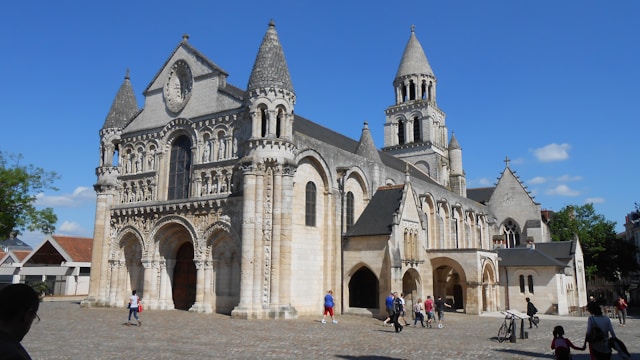
Important note for 2026 visitors: Notre-Dame-la-Grande is currently closed for major restoration works and will not reopen until 2027. The extraordinary Romanesque facade, however, remains fully visible from the square outside — and is, if anything, best appreciated from a distance.
The west front is a masterpiece of twelfth-century carving: tier upon tier of apostles, prophets, biblical scenes and decorative stonework covering every surface in a dense, dazzling display that rewards slow, careful attention. The Tourist Office opposite has set up a special exhibition including a video tour of the interior. On summer evenings, the church is illuminated with a colour projection recreating its original medieval paintwork — one of the most memorable sights in the city.
3. The Palais des Ducs d'Aquitaine
This is the hidden gem that most visitors to Poitiers overlook entirely — and it is extraordinary. The Palais des Ducs d'Aquitaine served as the residence of the Counts of Poitou and the Dukes of Aquitaine, and it was here that Eleanor of Aquitaine spent much of her childhood and later held her famous Courts of Love. Joan of Arc was questioned within these walls before being sent to face trial in Rouen.
The great hall — the Salle des Pas Perdus — is one of the finest surviving examples of medieval royal architecture in France. Three enormous fireplaces line one wall, and the light that filters through the stained glass windows creates an atmosphere that no description quite prepares you for. Entry is free, and guided tours are available in English during the summer months. If you visit only one building in Poitiers beyond the obvious churches, make it this one.
4. The Baptistère Saint-Jean
The Baptistère Saint-Jean is widely regarded as the oldest surviving Christian building in France, with origins dating to the fourth century on Roman foundations. The exterior is modest to the point of deceptiveness — nothing about the outside prepares you for what lies within.
Inside, an octagonal baptismal pool — still intact after sixteen centuries — sits at the centre of a space lined with extraordinary Merovingian and Romanesque frescoes. A small museum houses a collection of Merovingian sarcophagi and a Carolingian altar table. Admission requires a small cash payment, so come prepared. Allow around thirty minutes and bring a sense of historical wonder: you are standing inside a building that was already ancient when the Norman Conquest was five hundred years in the future.
5. The Cathédrale Saint-Pierre
Begun in 1162 by Henry II of England and Eleanor of Aquitaine on the ruins of a Roman basilica, the Cathédrale Saint-Pierre is a superb example of early Gothic architecture in western France. The interior stretches 89 metres from end to end and houses one of the finest collections of medieval stained glass in the country.
The great east window, depicting the Crucifixion and Ascension, dates from the twelfth century and remains astonishingly vivid — the deep blues and reds glow with a quality of light that modern glass-making has never quite replicated. Guided tours with English commentary run from June through to September. Entry to the cathedral is free.
6. The Musée Sainte-Croix
Consistently underrated and frequently overlooked by visitors focused on the city's churches, the Musée Sainte-Croix is a genuinely impressive regional museum built on the site of the old abbey of Sainte-Croix. Its collections span prehistoric artefacts, Gallo-Roman fragments and an extensive fine arts section covering painting and sculpture from the fourteenth century to the twentieth.
The building itself is architecturally striking — a confident piece of 1970s concrete and glass that sits interestingly against its medieval surroundings. Descriptions are primarily in French, but the museum provides English-language leaflets. Budget a couple of hours if history and art are your thing.
7. The Parc de Blossac
When the accumulation of medieval churches begins to blur, the Parc de Blossac provides a very welcome antidote. This elegant eighteenth-century park on the southern edge of the old town offers nine hectares of formal French gardens, an English-style landscape section, a small zoo, a café, and sweeping views from the ramparts across the valley of the Clain.
It is precisely the sort of unhurried, beautifully maintained green space that French towns do particularly well. Rosalie pedal cars are available to hire for those who want to cover more ground — a firm favourite with younger visitors and excellent fun for adults too.
Hidden Gems Most Visitors Miss
The Eleanor of Aquitaine Escape Game
This is one of the best-kept secrets in Poitiers, and one of the few activities in the city offered with full English-language content. Escape League, based near the former palace of the Counts of Poitou, runs an immersive escape game themed around Eleanor of Aquitaine that uses the city's history as its setting. It is a genuinely inventive way to engage with Poitiers' medieval past and consistently earns high marks from English-speaking visitors. Book in advance, particularly in summer.
Ilot Tison and the Guingette Pictave
Head down to the banks of the Clain on a warm evening and you will find one of Poitiers' most charming and least-publicised spots. Ilot Tison hosts a cluster of food trucks alongside the Guingette Pictave — an outdoor bar where you can drink at trestle tables on the riverbank as the sun goes down. It is entirely French, entirely unpretentious, and entirely the sort of experience that package holidays never deliver. An annual food truck festival takes place here every May.
La Maison des Parapluies
On the Grand'Rue, five generations of the François family have been handcrafting umbrellas in a tiny workshop using traditional techniques. La Maison des Parapluies is one of only five companies in France still producing craft umbrellas — a genuinely artisanal experience in a city increasingly defined by its medieval tourism. Even if you leave empty-handed, the workshop is worth a visit for the story alone.
What to Eat and Drink in Poitiers
No visit to Poitiers is complete without trying the city's distinctive local food. The Farci Poitevin — a traditional paté of vegetables, herbs and small amounts of meat wrapped in cabbage leaves — is one of the most emblematic dishes of the region and appears on the menus of most traditional restaurants. Tourteau Fromagé, a cheesecake with a characteristic domed black crust, is the dessert most closely associated with Poitou and is well worth seeking out.
For the full local experience, the covered market on the Rue du Marché Notre-Dame is the place to browse. Jérémie Chosson's cheese shop is particularly good for Poitou goat's cheese, and nearby Rannou-Metivier stocks Montmorillon macarons — nothing like the Parisian variety, these are substantial, chewy, brown and very good indeed.
For an atmospheric dinner, Les Archives — a gastronomic restaurant set inside a nineteenth-century Jesuit chapel next to the Mercure Poitiers hotel — combines exceptional food with one of the most unusual dining rooms in France. Book well ahead.
Day Trips from Poitiers
Chauvigny
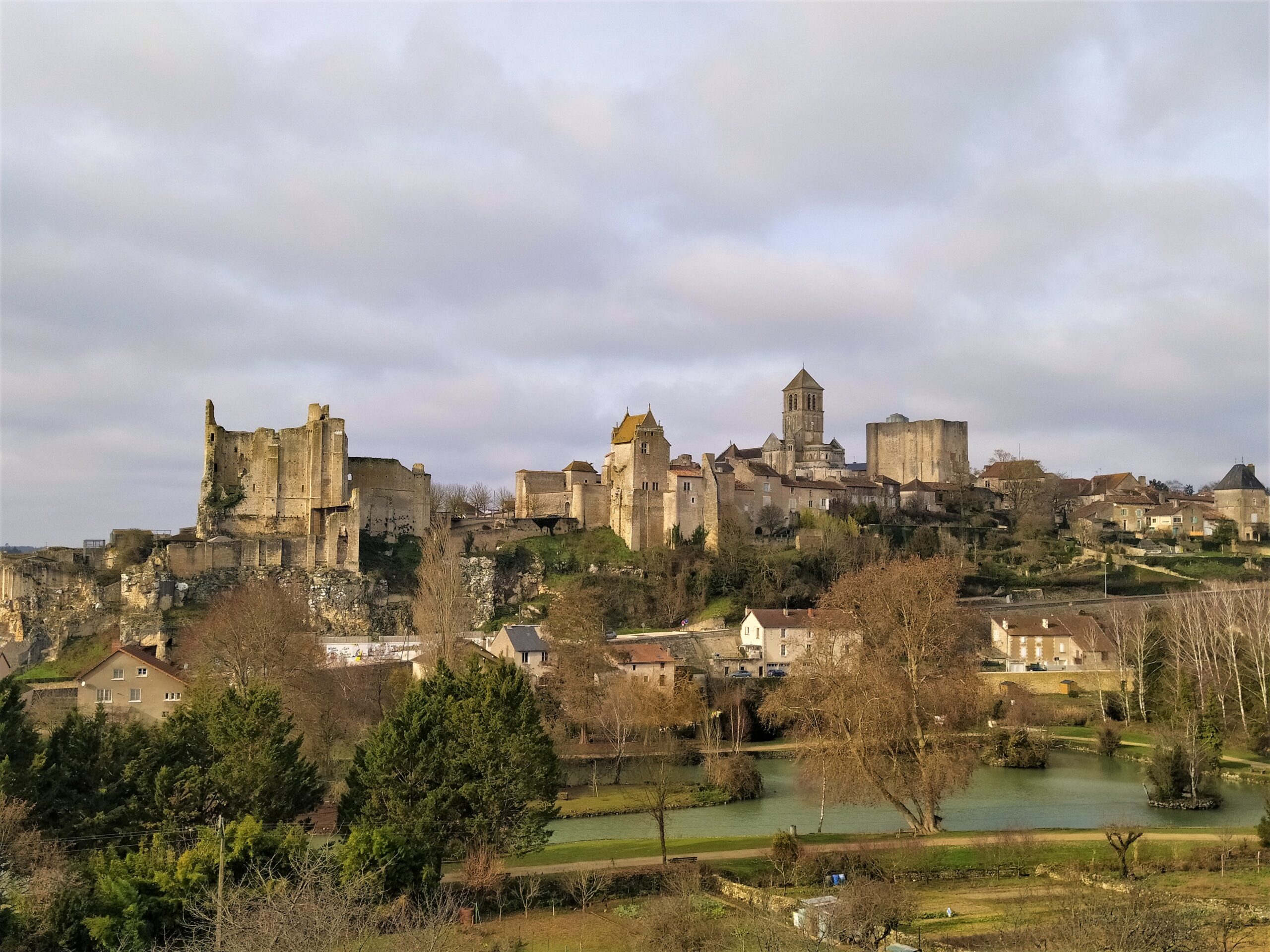
Just twenty minutes east of Poitiers by car, Chauvigny is listed among France's most beautiful detours. Five medieval castles crowd a single rocky spur above the town, and the collegiate church of Saint-Pierre contains some of the most vivid Romanesque carved capitals in France. One of the castles hosts a famous free-flying bird show in summer. A genuinely outstanding half-day out.
The Marais Poitevin
Sometimes called the Green Venice of France, the Marais Poitevin is a vast network of waterways and canals to the west of Poitiers — one of the most distinctive landscapes in the country. Flat-bottomed punt hire is available from several villages, and drifting through the tree-canopied channels on a summer afternoon is an experience that stays with you. Allow at least half a day.
La Rochelle
At around ninety minutes by car, La Rochelle is entirely manageable as a day trip from Poitiers — though its spectacular medieval harbour, excellent seafood, famous aquarium and Atlantic beaches make most visitors wish they had stayed longer. Many British travellers choose to combine several nights in Poitiers with a coastal stay in La Rochelle for the ideal contrast of city and sea.
Practical Tips for British Visitors
Notre-Dame-la-Grande is closed for restoration until 2027 — the facade remains visible and the Tourist Office has an excellent indoor exhibition. The Baptistère Saint-Jean requires a small cash entry fee — bring coins. Futuroscope is best reached by train (9 minutes) or hire car — buy tickets online in advance. Guided tours in English run June to September — check visitpoitiers.fr or download the free Visit Poitiers app. The GHIC card covers emergency healthcare in France on the same terms as French residents — carry it at all times.
See also: Poitiers Travel Guide | Flights to Poitiers from the UK | Best Hotels in Poitiers | Futuroscope: The Complete Guide | La Rochelle Travel Guide