They call it la ville aux cent clochers — the city of a hundred steeples — and once you have climbed to the viewpoint of Notre-Dame-des-Dunes and seen those spires piercing the sky in every direction, the nickname makes complete sense. Poitiers is compact, walkable, extraordinarily rich in history and almost entirely unknown to British visitors. This is how to spend 48 hours doing it properly.
This guide takes you through Poitiers neighbourhood by neighbourhood, with a suggested two-day itinerary, the best local food and drink, practical tips for getting around and everything a British visitor needs to know before arriving. For the full picture on getting here, see our complete Poitiers travel guide.
Getting Your Bearings
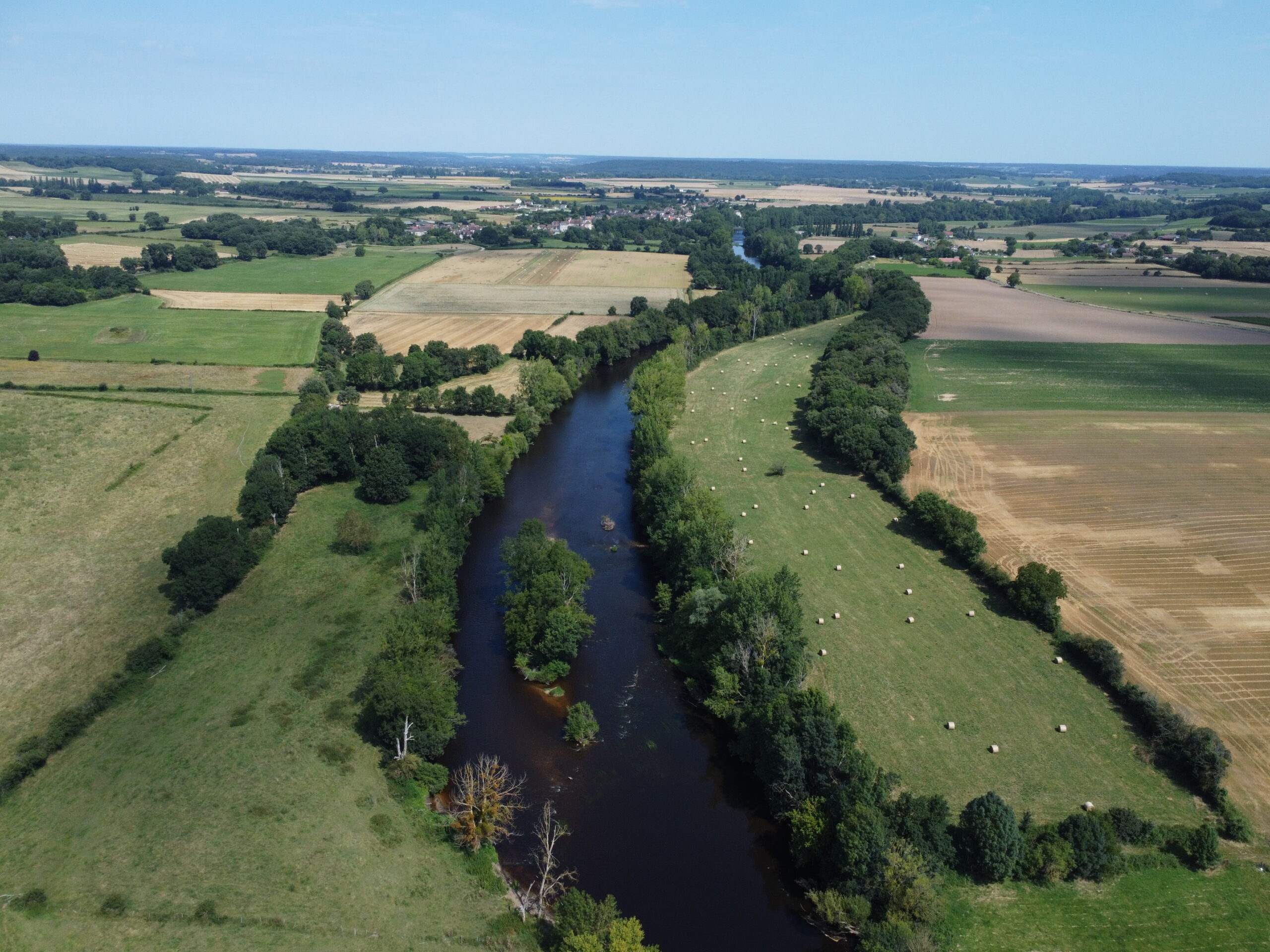
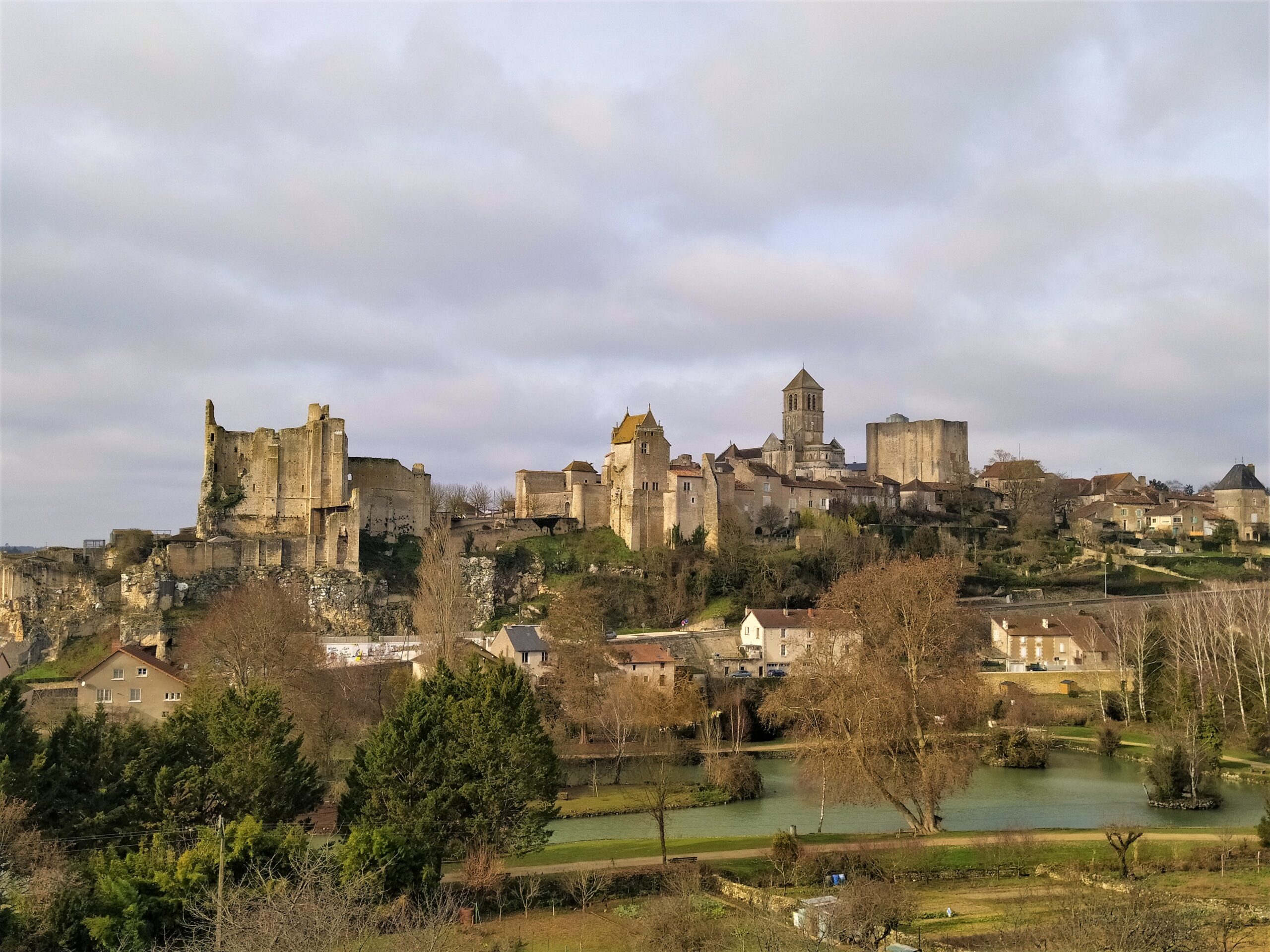
Poitiers sits on a limestone hill above the River Clain, and its geography has shaped the city's character ever since Roman times. The historic old town occupies the hilltop, its medieval streets spreading out from the twin poles of the Place du Maréchal Leclerc and the cathedral to the east. The university campus spreads across the southern and western edges of the centre, and the newer residential districts cascade down towards the river on all sides.
The good news for visitors is that almost everything worth seeing is within comfortable walking distance. The historic centre is almost entirely pedestrianised — a genuine delight — and the city's compact scale means you can cross it from end to end in under twenty minutes on foot. Hire a car for Futuroscope and day trips; for the city itself, you need nothing more than comfortable shoes.
Day One: The Heart of Old Poitiers
Morning: The Place du Maréchal Leclerc and the Old Town
Begin, as most visits to Poitiers should, at the Place du Maréchal Leclerc — the city's main square and its beating heart. This is where Poitiers reveals its dual identity most clearly: a city of medieval stones and student energy, of Renaissance town halls and café terraces crowded from morning to midnight.
The square has been the centre of Poitiers' civic life since the Middle Ages, when it served as a marketplace. During Eleanor of Aquitaine's time it was known as the Place du Marché Vieil — the old market square — and was the economic hub of the Duchy of Aquitaine. The handsome Town Hall that faces it today is a nineteenth-century creation, its bell tower watched over by four lead tigers, but it was built in conscious dialogue with the Garnier Opera House in Paris and has a grandeur that the square richly deserves.
Find a table at one of the terrace cafés — competition for seats can be fierce on warm mornings — and take a few minutes to simply absorb the rhythm of the place before setting out. Order a café crème and a croissant. This is France, and there is no rush.
From the square, head north along the Rue des Cordeliers, past the Cordeliers shopping mall — worth noting that its clothing rails sit beneath the arches of a converted medieval chapel, one of those Poitiers details that takes you by surprise — and follow the pedestrianised streets towards Notre-Dame-la-Grande.
Notre-Dame-la-Grande
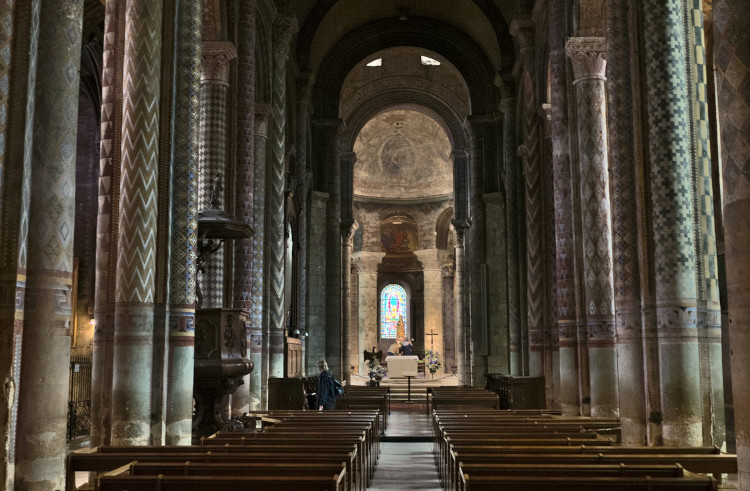
The church is closed for restoration until 2027, but do not let this deter you: the facade, which is the point of the building, is fully visible and utterly extraordinary. Stand back in the square opposite the Tourist Office and give the west front the sustained attention it demands. Tier upon tier of carved figures — the twelve apostles, scenes from the life of Christ, fantastical beasts and decorative stonework — cover every surface in a display of twelfth-century ambition that has not dimmed in nine hundred years.
The Tourist Office opposite has set up an excellent indoor exhibition about the church, including a video tour of the frescoed interior that is well worth twenty minutes of your time. If you are visiting in the evening during summer, come back after dark for the colour projection that recreates the church's original medieval paintwork: one of the most extraordinary sights in south-west France.
Late Morning: The Palais des Ducs d'Aquitaine
From Notre-Dame-la-Grande, walk five minutes south to the Palais des Ducs d'Aquitaine — Le Palais — the building that most visitors to Poitiers overlook and that rewards those who find it more than almost anything else in the city.
This was Eleanor of Aquitaine's home. She spent her childhood here as the daughter of the Duke of Aquitaine, and after inheriting the duchy at fifteen she made it the centre of her remarkable court. It was here that she held her legendary Courts of Love — part social experiment, part literary salon — where the troubadours of Poitou performed and the codes of courtly love were debated and codified. It was here too that Joan of Arc was examined by a council of clergy in 1429 before being sent north to lead the relief of Orléans.
The great hall — the Salle des Pas Perdus — is one of the finest surviving medieval royal interiors in France. Three monumental fireplaces line the walls, and light streams through stained glass windows depicting Eleanor alongside Henry II and their four sons. Entry is free. In summer, guided tours with English commentary are available — well worth booking if you can. Outside the entrance, the medieval Maubergeon Tower is one of the most impressive examples of a fortified keep in the region.
Lunch: The Covered Market and Local Food
For lunch on your first day, make for the covered market on the Rue du Marché Notre-Dame, a short walk from the palace. This is where Poitiers' food culture is at its most authentic and accessible.
The market is the place to encounter the city's distinctive culinary identity. Look for the Farci Poitevin — a traditional paté of vegetables, herbs and small amounts of meat wrapped in cabbage leaves, one of the most emblematic dishes of the Poitou region and available at several stalls in various forms. Jérémie Chosson's cheese shop is essential: the Poitou goat's cheese here, from farms in the surrounding countryside, is some of the finest in France — soft, fresh, slightly lemony — and infinitely superior to anything available in British supermarkets. Pick up a Broyé du Poitou, the region's traditional shortbread, for later.
Nearby, Rannou-Metivier sells the macarons of Montmorillon — nothing like the Parisian variety. These are heaped-up rounds of brown, chewy almond paste, crispy on the outside, gooey within. They are very good indeed.
Afternoon: The Cathedral and the Eastern Old Town
After lunch, walk east along the Rue de la Cathédrale — one of the most satisfying streets in the city, lined with half-timbered houses, Renaissance stone facades and the occasional courtyard that opens unexpectedly into something quietly magnificent.
The Cathédrale Saint-Pierre, begun by Henry II and Eleanor of Aquitaine in 1162 on the ruins of a Roman basilica, is at the end of this street. Go in. The interior is ninety metres long and houses one of the finest collections of medieval stained glass in France — the great east window, depicting the Crucifixion and Ascension, dates from the twelfth century and glows with a depth of colour that modern glass has never quite replicated. Entry is free.
From the cathedral, head north-east to the Baptistère Saint-Jean — bring cash for the small admission fee. This is the oldest surviving Christian building in France, its foundations dating to the fourth century, its octagonal baptismal pool still intact after sixteen hundred years. The Merovingian and Romanesque frescoes lining the walls and the collection of carved sarcophagi in the small museum give this modest building a historical weight quite disproportionate to its size. Allow thirty minutes.
Late Afternoon: The Viewpoint and the Clain
For the definitive view of Poitiers, walk south from the cathedral to the statue of Notre-Dame-des-Dunes on the edge of the old town ramparts. From here, the city's nickname — the City of a Hundred Spires — acquires its full meaning: church towers pierce the skyline in every direction, and the green valley of the Clain stretches out below. This is the best photograph in Poitiers. It is free. It requires a fifteen-minute walk from the cathedral. Most visitors miss it entirely.
From the viewpoint, descend towards the river and the Parc de Blossac. Nine hectares of formal French gardens, an English landscape section, a small zoo, a café and a riding school — all of it impeccably maintained and reliably uncrowded. Rosalie pedal cars are available to hire if energy levels require mechanical assistance.
Evening: Ilot Tison and Dinner
As the sun drops, make your way down to the banks of the Clain and Ilot Tison — the riverbank gathering spot that most visitors to Poitiers never find. A cluster of food trucks lines the bank alongside the Guingette Pictave, an outdoor bar where you can drink with your feet effectively in the sand as the river slides past in the evening light. It is entirely French, entirely unpretentious, and the kind of experience that repays the detour handsomely. An annual food truck festival takes place here every May.
For a more formal dinner, Les Archives — set inside a nineteenth-century Jesuit chapel adjacent to the Mercure Poitiers hotel on the Rue Edouard-Grimaux — is the most atmospherically distinctive restaurant in the city. The vaulted ceilings and carved stone arches of the old chapel frame cooking that takes the regional produce of Poitou seriously. The grilled fish is excellent. Book well in advance.
Day Two: Museums, Hidden Streets and Futuroscope
Morning: The Musée Sainte-Croix
Begin your second day at the Musée Sainte-Croix, built on the site of the old abbey of Sainte-Croix and one of the most underappreciated museums in the region. The building itself — a confident piece of 1970s concrete and glass — is architecturally interesting in its own right, sitting with quiet assertiveness against its medieval surroundings.
The collections span prehistoric artefacts, a remarkable set of Gallo-Roman fragments uncovered beneath the museum during construction — including fragments of gladiator helmets and a stunning marble Athena unearthed by workers in 1910 — and an extensive fine arts section. The latter includes six sculptures by Camille Claudel, among them The Waltz: a discovery that consistently surprises visitors who had not expected to find work of this calibre in Poitiers. The museum also holds paintings by Rodin, Bonnard and Sisley. Descriptions are primarily in French; English leaflets are available.
Mid-Morning: The Legend of the Grand'Goule
From the museum, walk north to the church of Sainte-Radegonde — one of the city's least-visited major churches and one of its most interesting. Radegonde was a sixth-century Frankish queen who fled her brutal husband, took holy orders in Poitiers and founded a convent nearby. She is buried in the crypt of this church, where her tomb has been a place of pilgrimage for fifteen hundred years.
But it is the legend attached to the church that makes it worth seeking out for those who enjoy the stranger corners of French history. Radegonde is said to have slain a dragon — the Grand'Goule, or Big Mouth — who was devouring the nuns of the Saint-Croix Abbey. The painted dragon in the Musée Sainte-Croix is the physical trace of this legend, and it gives the city a rather wonderful mythological undercurrent that coexists entirely comfortably with its medieval Christian heritage.
Afternoon: Futuroscope
Take the train from Poitiers station — nine minutes — or a taxi north to Futuroscope for the afternoon. Even half a day at the park is worthwhile, though a full day is better. The nightly Son et Lumière show, which runs in summer and during school holidays, is the single most spectacular thing to do in the greater Poitiers area: a vast outdoor show combining water fountains, laser projection, live performance and pyrotechnics that leaves most visitors slightly stunned.
If time or budget is limited, prioritise Tornado Hunters — the newest major attraction, using full-immersion technology to place visitors inside a developing storm system — and one of the flying experiences, which combine physical simulator motion with panoramic projection screens to genuinely convincing effect. The evening show begins after dark and is worth staying for.
Getting Around Poitiers: Practical Notes
The historic centre is entirely walkable and predominantly pedestrianised. For Futuroscope and day trips, a hire car from Poitiers airport or the city centre is the most flexible option; the train is fast and cheap for Futuroscope specifically. Taxis are readily available from the station and central ranks. The city's bus network is adequate for reaching areas beyond walking distance; download the Vitalis app for real-time information. There is no airport bus from Poitiers-Biard — a taxi to the city centre takes around ten minutes.
The three Tourist Office walking circuits — colour-coded routes taking around an hour each — are a reliable framework for independent exploration. Pick up the map from the Tourist Office on the Place Charles de Gaulle, opposite Notre-Dame-la-Grande.
Shopping in Poitiers
The pedestrianised centre offers a mixture of French high street brands and independent boutiques. Fashion visitors will find both familiar names and specialist shops, with the Cordeliers mall housing international retailers — including Zara — beneath the arches of a converted medieval chapel. For authentic local goods, the covered market remains the best option: Poitou goat's cheese, regional wines, honey and the various traditional biscuits and pastries of the area make excellent gifts and picnic supplies.
La Maison des Parapluies on the Grand'Rue is worth a detour regardless of whether you intend to buy: five generations of the François family have been crafting umbrellas here by hand since the nineteenth century, using techniques that have changed little in a hundred and fifty years. One of only five remaining craft umbrella makers in France. The workshop is open to visitors and the story is as compelling as the objects.
Practical Information
The city is safe and easy to navigate. Most hotels, restaurants and tourist sites have English-speaking staff, though a handful of basic French phrases — hello, thank you, please may I have — are appreciated and open doors more readily than English delivered at volume. Carry your GHIC card for access to French state healthcare. Most shops close on Sundays; the covered market operates on Wednesday, Thursday, Friday, Saturday and Sunday mornings. Tipping is not expected in French restaurants but a small gesture for exceptional service is welcome.
For comprehensive information on getting to Poitiers from the UK — by air, rail and road — see our flights to Poitiers guide. For accommodation options, see our complete guide to hotels in Poitiers.
See also: Poitiers Travel Guide | Things to Do in Poitiers | Best Hotels in Poitiers | Futuroscope: The Complete Guide | La Rochelle Travel Guide